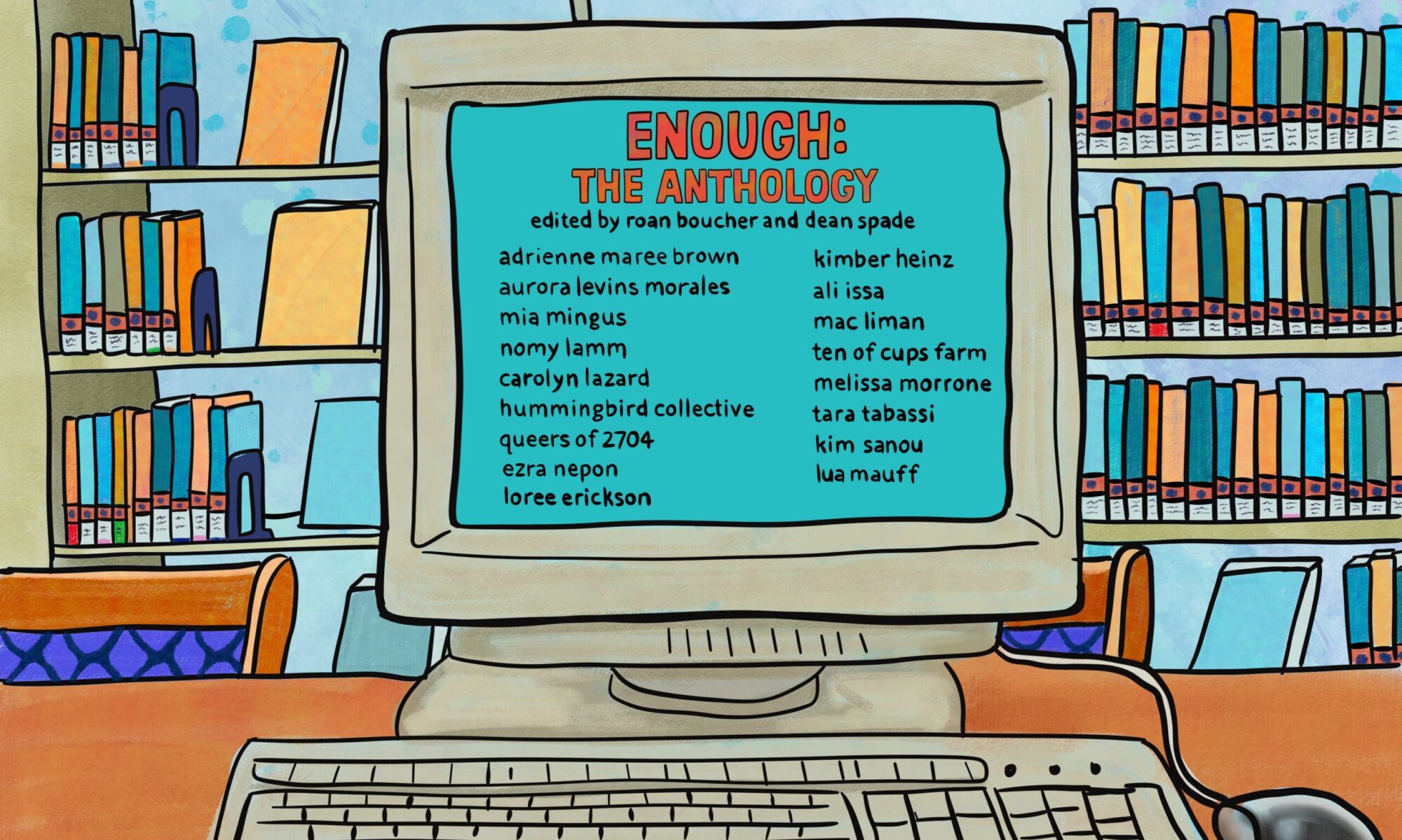
Roan Boucher and Dean Spade, 2026
INTRODUCTION to the 2026 Anthology
Our resistance movements have big visions. We’re working to dismantle capitalism, white supremacy, and colonialism; to build a new world without prisons, borders, bosses, or landlords. Our ideas and commitments are profound, and figuring out how to manifest them in our daily living conditions and survival strategies is deeply challenging. How do we develop the new world we want to live in from inside the conditions we already live under? How do we confront the ways that conditions of capitalism, neoliberalism, and white supremacy contain and influence resistance strategies? How do we live according to our principles when our basic needs are still produced by systems that hurt people, animals, and the planet? This collection of essays explores anti-capitalist experiments and reflections on these questions; they are a set of stories from people who are challenging these dynamics, in families, households, communities, organizations, and movements. These essays are generous offerings of people who are trying to find ways to live according to liberatory principles in a world shaped by severe injustice.
When we started the Enough website in 2008, we had both been talking and writing about these topics for years with other organizers in our communities. Enough began as an online zine/blog, with writing from the two of us along with many others; a response to a yearning in our communities for discussion about radical approaches to day-to-day decisions about money and resource sharing. We hoped it would spark conversations between people in our communities about how we all deal with money and generate collaborative experiments. The response to the initial project was so strong that we decided to create an essay anthology, where people could share their stories about things they had tried. We put out the initial call for essays in 2012 and got many wonderful submissions. We engaged the authors in editorial processes and worked to shop the book to different radical publishers. Then life intervened in several ways, and the project got delayed. A couple times we dug back in again, only to have another health issue, new baby, major project, community crisis, or something else hold us back.
Now it has been over a decade of holding on to these fascinating essays—along with a few more we collected along the way—and we are finally publishing them as a collection here. Some are just as fresh as the day they were written. Others needed notes updating on what happened next from the authors to bring them up to date. We hope they generate lively debates and new collaborations.
When we started this project over a decade and a half ago, we could not have known how much more relevant it would be in 2025 than it was back then. The global and US wealth gaps have widened horrifically since that time. The pressures of ecological crisis and pandemic have popularized the idea of mutual aid, and more people are relying on scrappy community projects for their basic necessities than ever. Rents and food prices are higher than ever, more people in our communities are unhoused, and ecological and economic collapse loom on the horizon. More than ever, we need to figure out how to share with each other, collectivize basic necessities, make decisions together, and destroy the apparatuses of extraction that control our lives. May the stories of many people’s humble and creative efforts contained in this project support that work for survival.
How did we get here?
By design, capitalism allows a very small percentage of people to accumulate massive wealth because of other people’s stolen, unpaid, and underpaid labor. Colonialism and imperialism produce widespread dispossession, enriching a few and creating ongoing vulnerability and violence for many. In the context of neoliberalism, new techniques for extracting and consolidating wealth have emerged, producing even greater wealth inequality in the last four decades. In the United States, the gap between rich people and poor people is getting larger and larger, social welfare programs have been dismantled, and essential infrastructure, resources, and services from public transit to education to fire fighting are increasingly becoming privatized. Police and military budgets increase annually, whether Democrats or Republicans are in office, while more and more people go without basic necessities. Under the second Trump administration, these conditions have only sharpened with increasing criminalization of poverty, brutal immigration enforcement, escalating war, and the opening of new prisons across the country.
Capitalism encourages us to respond to scarcity as individuals, striving harder and harder, rather than attacking the system through collective action. We are taught that it is shameful to accept support. We learn the myth of meritocracy—that if we work hard enough, it is possible for us not only to be secure, but to join the wealthy.[1] A 2022 study found that 44 percent of US adults believe they have the available tools to become billionaires. A 2023 study found that 69 percent of Gen Zers and 54 percent of millennials who don’t currently consider themselves wealthy believe they will become wealthy someday. We are taught that poverty represents personal failure. People born with wealth often cloak their position in secrecy, feeling shame about their unearned means. The resulting cultural taboos about money help keep people separated and impair collective action.
The social norms that sustain capitalism can limit our ability, even in radical communities, to conceptualize creative responses to oppression and injustice. This can manifest both in how we build movements (reproducing bureaucratic, hierarchical, business-type models; packaging and “selling” social justice work to foundations in exchange for grants; conceptualizing an individualist model of “social justice entrepreneurship”), and in how we deal with personal finances in our own lives (defaulting to patterns like hoarding, consumerism, and individualism in how we conceptualize our lives, futures, and economic security).
Class privilege and capitalist dynamics function even within communities and the lives of individuals working to fight oppression and economic injustice. People hide details about their income, inheritance, class background, debt, and spending. Silence and secrecy about money make it difficult for us to challenge each other and ourselves when classist dynamics arise. Social conditioning trains us to hoard money rather than share it and build community.
As anti-capitalists, we also face dilemmas that come from living within a system—relying on it for survival needs—that we seek to dismantle. We imagine alternatives to capitalist healthcare, banking, childcare and housing systems, and so much more, yet for the most part our movements do not yet provide alternatives to participating in existing systems. We live inside these contradictions, often experiencing shame and frustration at our ongoing relationships with violent markets and institutions to meet our individual needs. Many people hope that a new way of living will be provided by some future government, that we can elect people who will create free health care, universal basic income, free transportation, a food system not based on fossil fuels, and the like. But with conditions sharpening around the globe as consumer industrial society unravels, and fascists in power in so many places, it is clear that we cannot wait for anyone else to solve our problems, we need to create local, collaborative, horizontal ways to meet our needs as quickly as possible. Our experiments, even though they are often partial and imperfect, are essential inspiration for these times.
When we created Enough, we were responding to several concerns: the critique of the nonprofit industrial complex (enlivened by INCITE!’s 2004 conference and 2007 anthology, The Revolution Will Not Be Funded); frustration with philanthropic control of movements and persistent scarcity and competition between movement groups scrambling for philanthropic resources; recognition that capitalist dynamics are internalized within and limit resistance movements; lack of openness and transparency about money in our communities; and strong social pressure to accumulate and manage resources individually rather than collectively, resulting in most people feeling and acting far outside their values in how they actually managed money and basic needs. The essays on Enough have explored these concerns through discussions of radical poor people’s organizing, spiritual practice, challenges to traditional philanthropy, relationships with birth and chosen family, professionalism and academia, debt, property ownership, giving away money, and more.
This body of work recognizes that individual choices about giving away money or avoiding certain consumer practices are not sufficient nor the central strategy for ending capitalism, but that as we analyze and oppose broad scale arrangements of maldistribution we must also examine their impacts on our daily decisions, communities, and relationships. Building alternative structures includes small-scale immediate alternatives for resource sharing, managing feelings of scarcity, and renegotiating ways of being. We are inspired by the creativity of small-scale alternatives being experimented with and developed by activists to meet their daily needs in the context of work to dismantle capitalism, white supremacy, and colonialism. We believe that sharing these stories with each other, including our failures and false starts, can help proliferate such experiments. In times like these, it is essential not to dismiss interventions for being small. Small-scale efforts that can be inspirations for others to experiment with, change, adapt and build upon are what produce transformative bottom-up change. Capitalism and the state enforce large-scale ways of living from above, colonialism, war, extraction, and regulation that puts our lives in the hands of elites and corporations. The most effective resistance methods and disaster relief approaches will inevitably be, and should be, local, experimental, humble, adaptive, self-organized, and self-critical.
These essays explore ways that we conceive of and are living a politics of interdependence, resource sharing, and wealth redistribution. They are by and for organizers, activists, artists, and cultural workers directly engaged in resistance movements. They are rooted in anti-capitalism, feminism, and racial justice, as well as critical disability, decolonial, and queer and trans resistance politics. As such, they create space for contributors to be (self)critical of our movements and share strategies that are based on an analysis of our current strengths and weaknesses, and can serve as a tool for discussion and debate.
We hope that sharing this collection now inspires further reflection, discussion, practices and experiments with disrupting and dismantling capitalism as we care for each other and struggle for a different world.