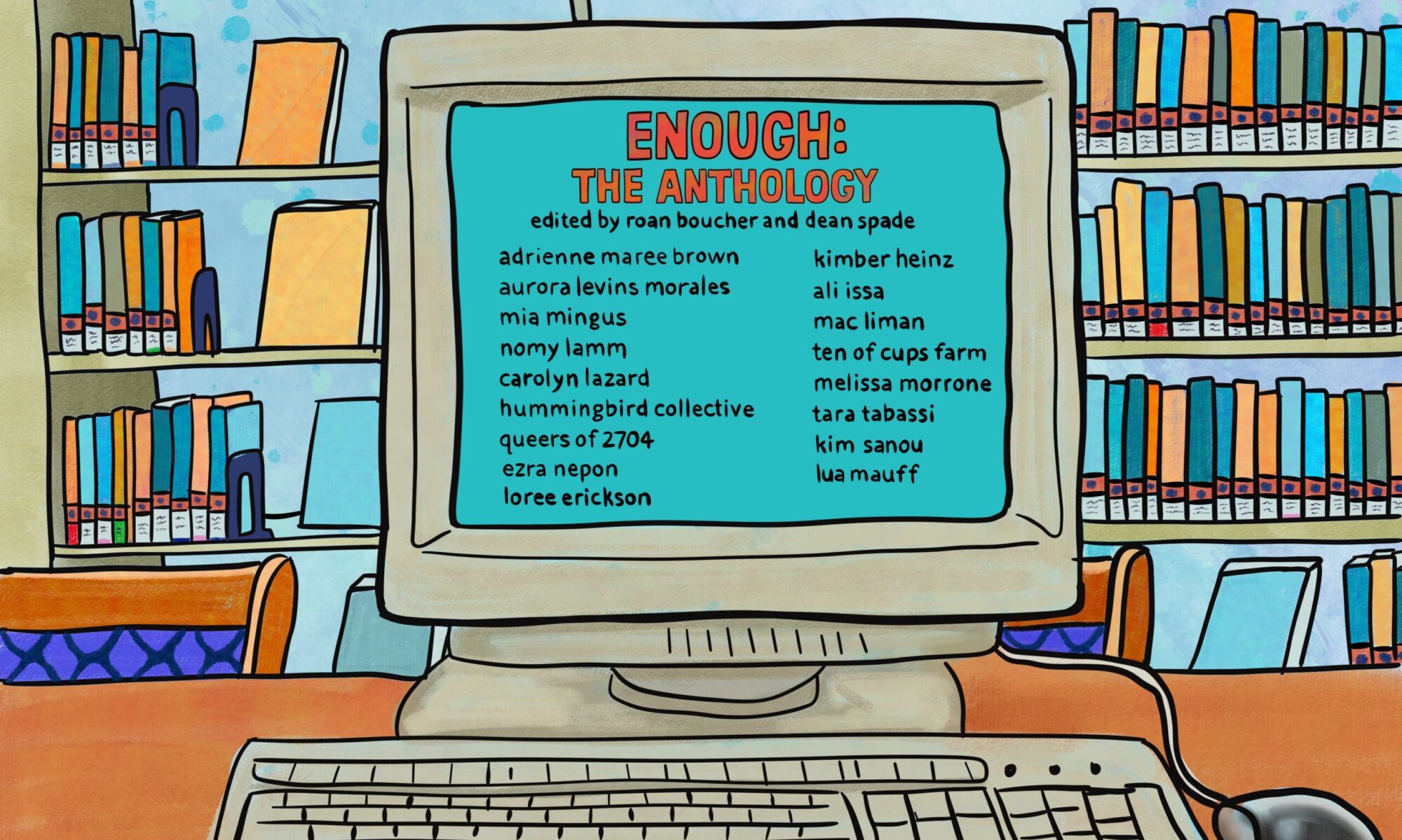
Nomy Lamm, 2012
My cat is pawing at my face before the street cleaner comes by, rubbing her teeth against my knuckles, reminding me to take her to the vet soon, the crusty thing on the back of her neck is getting grosser by the day. She’s ancient, at least eighteen, black with big kittenish yellow-green eyes, her health a delicate balance of expensive wet foods, powders to make her poop, an electric water fountain, and occasional trips to the vet to squeeze her anal glands and trim her nails. Now this thing that’s been on the back of her neck for ten years is starting to ooze and crust, and I’m on my own, this isn’t Aura’s responsibility anymore, I can’t just ask her to put it on her credit card. And yesterday two thirty-dollar checks from the Department of Rehab disappeared into thin air, I had them in my hand and then they were gone, I looked everywhere: in my cubby in the hall, on top of all the bookshelves, in all the piles in my room, in the recycling. I’m pretty sure my bank account is overdrawn. So, that’s what I wake up thinking about. Money.
My eyes meander across the long yellow room with its high arching ceilings, the flat morning light filtering in through the blinds, the sounds of Folsom Street willing me into the world – cars, a motorcycle, and now a siren, and now the sound of an accordion from across the street. I put on a turquoise and white striped dress with fringe along the neck and hem, and open the blinds to let the light in. I clear off surfaces, tidying up my piles with an eye out for those checks, then go to the kitchen to make my morning coffee.
My new voice student, Bernice, is five minutes early. She is nervous and giggly, clutching a pink vinyl bag to her chest. I invite her to come down to the kitchen while I finish making my coffee. She sits at the pink formica table while I heat milk in a pan. She’s an herbalist, I met her through a queer anti-violence project.
“I love your house,” she says, her head swiveling, taking in the checkered floor, yellow walls, the clutter of a loved home, pointing up at the aprons that hang from lines across the ceiling. “These Victorians are so beautiful.”
“We got super lucky,” I tell her, plunging the coffee. “When Aura and I moved in we didn’t have to sign a lease or pay a deposit or anything, we just met with the landlord and he was like ‘Welcome to the family! Stay forever!’” This is a rare story in San Francisco.
“That’s a dream come true,” she twirls a tendril of black curly hair around her finger. “But how is he about fixing things when they break? That’s the problem with easygoing landlords, they think they don’t have to do anything.”
“He actually does take care of things.” I offer her some water and lead the way back out of the kitchen. “See, like the new paint job?” I gesture to our pink and blue living room. “He paid for that. We even got to pick the colors, we wanted it to look like a cupcake.” I open the door to the front hallway and lead her toward the front of the house, to my room.
“I hope I find a good place to live soon,” Bernice says, pausing to look at the books in the hallway. “I’ve been here four months and I’m still couch surfing.”
This is a familiar story.
“That’s so hard. You’ll find something,” I tell her, noticing tension in my own belly, the anxiety of uncertainty. My new date Chaps is in a similar situation.
When we enter my room Bernice’s face lights up and her smile gets even bigger. Gold frames, painted unicorns, musical instruments, tchachkes and altars, a tarot spread on top of a bass amp, stuffed animals and a leafy red begonia. This is my realm.
“It feels so good in here. I love this.” She points to a drawing of two crows, their feet clasped together, spinning in the air.
“That’s love,” I say, reaching my hands out into the air, imitating the crow feet. “That feeling of equal meeting in freefall, holding on and swinging through the universe together.” She is looking at me with sparkly eyes. “I try to meet all my moments that way,” I say, feeling exposed, but that’s what I like about teaching voice lessons in my bedroom. Opportunity to share my magic.
I sit in front of the electric piano and instruct her to take a seat opposite me. I prop my fake leg up next to the heater.
“Let’s find ourselves in the room,” I say. “Close your eyes and just notice the subtle movement of your breath… the sounds of the environment…” The noisy belch of a bus coming to a stop outside. The mechanical trickle of the cat fountain. A group of teenagers on break from school.
“Acknowledging and thanking the Ohlone people whose land we are occupying… we sense into our relationship with gravity, the parts of our bodies making contact with the floor and the chair… releasing into that support…”
I watch her, long eyelashes resting on her smooth brown cheeks, black curly hair piled high on her head, her palms flat on her thighs, thumbs sticking through the holes of her hoodie, trusting me. We practice emptying our lungs all the way out, filling all the way back up, noticing the difference. We stretch, expanding and contracting our whole bodies, pretending our faces are the center, like a starfish. We rev our lips like motorboats and make hahaha noises, let our jaws hang and shake them out, make siren sounds and sing long open notes pushing air through each of the vowel sounds. Acting silly, getting the body ready to sing, helping the mind let go of judgment.
Bernice loves to sing but she holds herself tight in her guts. She doesn’t know how to notice when she goes out of tune, but she can tell something’s not right. We do some exercises at the piano, I ask her to ground into her feet, lift up through the top of her head, breathe big, open up. She starts sounding more relaxed and this deep, clear voice comes out. We sit facing each other again and play with sound, improvising, seeing what comes out, letting our voices merge and interact. We sway in our seats, waving our hands, moving energy around, and then the soft sound of a harp coming from my phone lets us know the hour is up.
“That was amazing,” she says. We sit with the tangible presence buzzing in the air between us. “Ancestors.”
“Yeah.” It feels so good to be recognized and present with another person.
“Wow,” she says, shaking herself out of it, digging in her bag for her wallet. She hands me twenty dollars. “So I’ll come back on Thursday to make tinctures with you. I was thinking we’ll start with hawthorn – good for the heart.”
“Awesome.” We negotiated a partial trade, twenty bucks a lesson and then she’ll teach me about herbal medicine. The cash is supposed to go into an envelope in my underwear drawer, which I then try to forget about. Sometimes it grows. Today, though, as I’m putting the money in, I realize I have to harvest. I count out five twenties, everything I’ve managed to save, and stick it in my bra.
As I’m letting Bernice out I pick up the stack of mail lying on the floor in front of the mail slot. There is a statement from the bank. As I thought, my account is overdrawn and they’ve charged me an extra $22. The balance is negative $99.27. Staring at the number I feel my bubble of presence dissipate into the gridwork of survival. Where the hell could those checks have gone? They were in my hand, and then… Then there’s more mail from the Social Security department, telling me I owe them $2,976, which they will slowly take from me, $50 a month. I’ve already been over this with them, I don’t actually owe them anything, but I will have to go back to the office to argue with them about it again. This time I will have to get it in writing.
I leave the house with a list of errands, the hundred dollars from my underwear drawer, and a stack of letters from Social Security. As I’m walking to the car I hear the call of crows overhead. I stop and look up at them as they swoop across the street, disappearing over the rooftops.
“Caw! Caw!” I shout.
They ignore me.
I get in my car, a purplish brown cube, roomy, comfy, ok gas mileage, cute and weird. I bought this car with settlement money last year, after Aura and I won a class action lawsuit against our old landlords, who let the elevator of our six-story apartment building sit broken for eight months. I take down the disability placard and pull out of my parking spot, thinking about Aura and our little studio in the Tenderloin. At the time I was freshly approved for disability benefits, not working, not producing, not sure what to do with myself. Then the elevator broke and I was cloistered in that apartment with nowhere to go, writing down my dreams, meditating, singing, lighting candles, drinking tea, setting intentions. Listening to the sounds of the streets outside: Sirens, fights, negotiations, cops giving orders over loudspeakers, girls crying and screaming in the middle of the night. Sometimes if I laid in my bed and looked out the kitchen window at a specific angle I could see a tulip tree in an alley somewhere. Beautiful, beautiful, I would sing to the flowering tree, happy to be able to access some tiny piece of the natural world.
Now I live here, in the Mission. Aura is across town. We have separate lives. She is probably at band practice right now. It is February and it is sunny, one of the miracles of San Francisco seasons. I wonder if this is because of global warming. I feel spoiled. This city is amazing, one of the most expensive places in the world to live, and I seem to be floating through, held aloft in this tiny bubble I have come to think of as Socialist America.
Here’s the deal with Socialist America: The government pays my rent. The government pays my bills. The government pays for my psychotherapy, my bodywork, and my physical therapy for pelvic trauma. The government pays for my shiny black-patterned prosthetic leg and the swim foot that sticks on the end of my little leg so I can wear flippers when I swim laps. The government pays for my car insurance and oil changes and sometimes for registration and repairs. The government pays for clothes and shoes for school, but they have stopped covering bras and underwear, claiming they are not necessary. The government pays my tuition and pays for books and supplies and even mileage on my car. The government bought me a computer, though they won’t pay for its repairs. And, though I have a prescription and can legally have it delivered to my house, the government does not pay for my weed.
In exchange, I track and print receipts, collected in big manila envelopes, submitted for approval every six months. I give the government full access to my bank accounts, fill out paperwork for re-assessment at regular intervals, and battle over incremental losses, spending hours on the phone and in waiting rooms, trying to keep myself securely and justifiably within the system. Keep all the different accounts in order, keep it all looking legal and legitimate. Social Security, Medicare, the Department of Rehabilitation, these are my patrons. I wormed my way in, spent years decoding this system, slowly accumulating resources, tracking what is available, negotiating between agencies, untangling bureaucracy. Somehow in this pocket of decline, with all the defunding of social services, the widespread joblessness and homelessness, I found this cradle.
Driving through the city, past my old apartment, I say thank you thank you to the broken elevator that bought me this car, that corner of the city where I first planted myself, where girls outside wait for customers, where I once saw a crow perched on the roof across the alley, looking in my kitchen window at me. It was the only crow I saw that first year in San Francisco, and I had been watching for them. In the northwest they are everywhere, hanging out on electric wires, playing pranks, acting like people. (Once I saw a pair of crows walking across the street in a crosswalk, stopping traffic.) Here in San Francisco I have learned to attune to their call, have learned to recognize the difference between a crow and a pigeon from a distance: the forward thrust of the head and neck, the more streamlined arc of the wings. I get excited when I see them, I call out to them, longing to connect. I wish I could hug them, I want to touch them, but I tell myself I don’t think they would like that.
I pull onto the back road that leads to the parking lot of my credit union. There is construction, as usual, orange cones and diamond-shaped signs. I park in the disabled spot, go inside and use the ATM to deposit my five twenties. It’s taken me a while to figure out the rules, for some reason the money goes in quicker if I deposit it through the machine instead of a teller; mechanisms that have nothing to do with laws of nature. I don’t get it, but I learn the rules and follow them, try not to take the randomness personally. The machine spits out a receipt, I now have sixty-three cents in my account. Plus twelve dollars and change in my wallet. Three more days to the first of the month.
When I walk back out of the bank, the first thing I hear, louder than the backhoe, is the sound of screaming crows. I look up. What is wrong? They are swooping and diving, they’re pissed, freaking out. I feel my own agitation, the way my heart leaps around with the patterns of their flight, and follow them out of the parking lot. There, lying in the street, is a big, black, dead crow.
“Oh no…” My heart seizes. I look up. No wonder they are so pissed. “What happened?” I look around for construction workers, wondering if they saw, if they know. “Did you see what happened?” I yell, but they don’t notice. They are busy, not paying attention to me, or the crows.
I can’t just leave it lying in the road. Again, I look around. There is a bush across the street with bark under it, I could lay it there and at least it won’t keep getting run over.
“I’m so sorry about your friend,” I call up to the ones keeping vigil overhead. “I’m going to move it okay?” They don’t stop screaming.
I bend down and pick it up. Its body is warm. As I turn it over, its head flops to the side and its big scaly grey feet stick up at me. I get to see up close its wrinkled skin and talons, the big strong black beak, the gleaming feathers, feel its strong body in my hand. It’s perfect. I actually wonder for a minute – am I dreaming? The crow friends overhead quiet for a moment and I see that they are flying to the corners of various buildings framing the alley. They are making a circle around me. I walk carefully over to the bush and gently lay the dead crow down in the bark. I start to say the kaddish, yitkadal v’yitkadash sh’mey rabah… but can’t remember much. I look up into the blue sky right as one crow flies over my head. A feather drops from its tail and I watch it helicopter to the ground, coming to rest underneath a car. I lie down on the pavement next to the car, using my cane to fish it out. Suddenly a man is standing over me.
“Are you okay ma’am?” He’s an older black man in an orange polo shirt, grabbing at my arm, trying to pull me up.
“I’m fine, I’m just, I’m trying to get this feather.” I try to wave him away.
He hovers there as I use my cane to drag the feather from under the car. I pick it up and inspect it before hoisting myself up. The man grabs at my elbow again.
“Thanks, I’m fine,” I tell him. “See?” I hold the feather toward him. It’s about four inches long, black with a purplish-greenish gloss, contrasting a milky white rachis.
“What’s that?” he asks. “Raven feather?” He holds his hand out toward it, but he doesn’t grab.
“I think these are crows, because they sound like ‘caw!’” I point my finger in the air and we listen. “Ravens have more of a rattle.”
“Right, right. And aren’t ravens bigger than crows?” he says. “And they have those mustaches.”
I laugh, and he laughs, and something flashes between us. I can see my own desire reflected in his eyes, and then I’m nervous.
“Look,” I point the feather toward the bush, where the dead crow lies. There is a cat! – out on the street in the Tenderloin! – a big orange tabby, sniffing at the crow. It looks fed, soft, protected. What is it doing out here?
“The circle of life,” the man says. Then: “What happened to your leg?”
I look away. I breathe in my environment. The screaming birds overhead, their dead friend being swatted at by an escaped housecat. The intermittent sound of a jackhammer at the end of the block. A car drives by, scaring the cat. I watch its orange tail disappear down an alley, breathing in the smell of tar and sidewalk pee, mixed with the man’s very strong cologne.
“That’s never the first thing I tell people about myself,” I say, smiling, starting to walk away.
“Oh! It’s like that!” he teases, following me as I walk toward my car. I feel aware of my limp, and of him watching me. “Should we get to know each other over a burger?”
“No thanks,” I say, getting in the car. I can’t help but smile. “Places to go, people to see!” I gotta get to the Social Security office. I am hungry though. I wave to him as I pull away.
I drive past the park where I usually swim three times a week. Day laborers crowd around a trash can, playing cards. A little girl with a sparkly headband stands on top of the slide, her hand over her eyes surveying her territory. The pool has been closed for a month and a half, and I feel it in my body, stiff, clenched in the right hip, vibrating metallic energy from my pelvis where the strap used to be buckled tight for all those years. The strap isn’t there anymore, I remind myself. The longer I go without swimming, the more I wiggle in my seat, digging the edge of my fake leg out of the fold of my hip, feeling trapped.
In my worst fantasies, I’m forever owned by this lineage of control that’s implanted itself in me. The Shriners, those lovers of poor crippled children, they colonized my body, they cut off my foot and brainwashed me to emulate normal. Like the body doesn’t matter. Like I should spend my whole life proving myself, measuring myself against other people, trying to show how special and capable I am. It’s taken me over thirty years to be able to say that I know deep down that it didn’t have to happen that way. I could have kept my foot. I could have worn a fake leg with the toes of my little foot sticking out the front. Or I could have hopped everywhere. Or I could have lived on the side of a hill and only walked in one direction. Or I could have built a giant spring to bounce on.
I circle the block, looking for parking, thinking about options. There’s a formula you’re supposed to follow, when you’re born you start the process, the train isn’t gonna stop for you. Even if something totally insane happens to you, like they cut off your foot when you’re three years old, you still have to keep growing up, learning to read and do math and jumping jacks, taking tests, getting socialized, going to school, learning to work, worrying about money, denying any deeper needs because you don’t even get to stop and see what they are, you’re not supposed to get a break. But I believe I have found a loophole. For the moment at least. It wasn’t easy to find. I had to slip through the cracks of Capitalism into a deeper web of time, chart the days spent crying in bed, the pain, the hole where the pain should be. The place in my back and hip that I can’t feel, a buzzing forcefield of numbness.
At thirty years old I landed back in my mom’s house, living on GA-X while I waited for the government to decide my fate. I would lay in bed crying, listening to the voices of the volunteers in my mom’s basement wafting up through the heating vents, volunteers who answered letters for Books to Prisoners. There’s a whole library down there. I would listen to them talk about the prison industrial complex, their political arguments merging into my own obsessive vision, the uprising I’ve been planning since I was three years old: How to get the kids out of the hospital so we can play! I would lie there frozen in bed, my pelvis buzzing, like a foreign object had been placed inside my body and plugged into an electrical outlet. There was nothing else I could do. This is how bad it has to be to get a break.
Now I’m parked outside the Social Security office. I can’t move. My heart is beating too hard, I can’t get a deep breath, my thoughts are looping. I’m remembering how they wanted to know why I didn’t go back to work for my dad. It says here you worked as a receptionist, my case worker said. When I was fifteen! I panicked. I’m not a receptionist, I can’t sit that long in one place, it hurts too much, I need to lay down, I need to move around, I need some fucking time to figure this shit out, I can’t keep pushing myself and then crashing like I have been, I can’t do it… I was counseled by friends who’ve been through the process to be as pathetic as possible, to cry, but to be specific, tell them what’s hard. Tell them I can’t get out of bed, can’t stop crying. Don’t play to my strengths. Gotta show them how bad it is.
I find some deeper breaths and remember my tools, noticing the sounds in my environment (car, car, a guy riding past on a bike with a boombox playing “Eye of the Tiger). Noticing the support of gravity, my butt in the seat. I don’t need to be that pathetic anymore, life is actually good, and I’m in the system, I don’t have to work so hard to prove myself, I just gotta keep track of my shit. For someone who didn’t pay taxes for years, who believed that the whole structure was about to crumble, that we were building something else to replace it, I have managed to magically submit and organize myself within it pretty effectively. It is survival, and protection, for now. I grab the letters from Social Security, my wallet and my cane, and emerge from my lego car onto Valencia street. Need food. Look around. Healthfood store down the block. Getting that light-headed panic, that belly-full-of-coffee feeling. I walk down the street, focusing on the tension in my hips, trying to relax, to not treat the one-block walk as an endurance test.
I enter the health food store urgent for protein, fill a bag with organic almonds and take them up to the register. “Seven dollars and forty-two cents,” says the guy behind the counter. “What? It’s not even a meal,” I scowl. He looks away. I pull out my wallet and count out seven one-dollar bills, a quarter, a dime, a nickel and two pennies. I feel myself kind of hovering over my body, managing myself, coaxing myself along. I walk quickly back to the Social Security office, feeling swift, the ground moving beneath my feet, pushing off from the pavement with my cane. The security guard nods as I enter the somber old marble building, and I take a number. E4. All the numbers up on the board are A, B and D. No E. There is a woman trying to speak English to a clerk, she needs a Social Security card. The clerk realizes she is not a citizen. “You can’t have a Social Security card,” he tells her. A 20-or-so year old dude is listening to his headphones really loud. I bet it sounds good to him, but all we hear is the really tinny annoying part of it. The security guard taps him on the leg and gestures for him to turn it off. Dude ignores him, won’t look at him, but then he does turn it down. I scoot past an elderly Asian couple and a middle aged Black woman with long gold fingernails, to an empty seat near the window. I take off my leg. This will probably take a while.
I look around and think about how we could all organize together and overthrow the system. I used to have so many good ideas. Alone in the hospital without anyone who loved me, I would think very seriously about the games I wanted to play with the other kids, when and if I had the opportunity. We would play so good that our world would get stronger, we would get so powerful that we couldn’t be stopped by the doctors and nurses who held us prisoner there, not even by the Shriners, with their weird faux-Arabian Fezes decorated with Masonic symbols, their clown makeup and tiny cars, their zombie eyes that cast a metaphysical grid of impossibility around our reality. We would have to do it from the inside out. The game would evolve, the dream would never end. This is the dream. This office. This is what humans created. I am creating something else. Not by fighting it. By releasing my fire into it. Electrifying the neurons. Zap zap. My body drains batteries, I’ve watched it happen. I eat my almonds.
E4 is announced over the loudspeaker. It flashes in red at counter number three. I stand up and begin the process of putting on my leg. Hike up my skirt, pull the prosthetic sock over the top of the socket.
“E4!” Yells the lady at counter three.
“I’m coming,” I say, twisting the socket so that it’s aligned when I push down into it.
“E4!” she yells again.
My leg suctions into place and I collect my wallet and the stack of letters, grab my cane, and cross the wait area to counter three. “You know, I’m here because I have a disability,” I say. “It takes a minute.”
“I didn’t see you,” she says. “ID?”
I give her my license and show her the most recent letter I received. I try to explain the situation. They’re taking away more money than they are supposed to. I’ve already been here and they said they fixed it. Her nails go clickety-clack on her keyboard.
“Take a seat, someone will come out that door on the left and call your name.”
I sit back down, unsure of whether it makes sense to take off my leg again. I want to ask how long it will be but she’s with someone else now. I perch on the edge of the seat. After a minute I try to sit back in the chair, but the socket pushes my left side up, wrenching my spine, digging into my hip. The buzzing in my pelvis gets stronger. “Fuck this shit,” I mutter, but not too loud. I can’t sit here like this. I need to be comfortable. I push the button that releases the valve that allows in air which releases the suction so that I can pull my little leg out of the socket. I prop my fake leg up against the chair next to me, shiny black socket that shows the exact shape of my body, striped black and white sock covering the leather calf. Sensible gold mary jane shoe. Mechanical knee visible in the back. People don’t stare too much. I appreciate the veneer of privacy.
My phone buzzes in my pocket. 402 number, where the fuck is that? For some reason, I answer it.
“Hello?” I’m already annoyed.
“Hi, is this Magdalen Clew?”
“Yes, who is this?” I say. Shit, the security guard is looking at me.
“Hi, my name is Brian, I’m calling from the Human Rights Campaign. As you know, we’ve had some major wins lately, with gay marriage in (blankety-blank) states, and the recent repeal of Don’t Ask Don’t Tell, but the Republicans aren’t sleeping, and neither can we, now we are asking you to partner with us, to show your support for the important work that the Human Rights Campaign is…”
The security guard points to a sign that says NO CELL PHONE CONVERSATIONS. Then he points to the door. I wave my finger and shake my head, pointing to my leg.
“Hey, Brian, I have to interrupt you, I’m sure that’s great for a lot of people, not so much for me, I mean, I’m queer but I’m not into the military…” Maybe I shouldn’t have said that out loud in the SSI office. The elderly couple across from me stares straight ahead, not registering a reaction.
“Okay, so you’re gay, so you know how important marriage equality is,” says Brian, with a familial lilt. “Certainly important enough to support with your hard earned dollars and cents?”
“Well, I have to tell you, right now I’m sitting in the Social Security office,” I say. “I’m trying to get the government to stop taking away money that I need. So you should probably move on to the next person on your list, since I can’t give you anything.” I say it all in an even tone. I used to be a telemarketer, so I always try to talk to them like they’re people. It’s hard, because they have a script they have to follow, and they are being monitored.
“Well, we’re not just looking for a financial arrangement, we’re really looking for friends,” says Brian.
“You want to be my friend?” This makes me laugh. Now the security guard is coming my way. “Shit, Brian, I gotta go.”
“Well for just a hundred and twenty dollars, and you can pay that in installments of just ten dollars a month, that would make you a junior level giver, and that would go a long way towards making sure the Republicans can’t take away our rights – yours and mine.” Brian is doing a good job of following the script but also keeping his voice friendly and personable, like it’s just the two of us having a conversation.
“You know, I would love to argue about this with you more, but the security guard is coming over to tell me to get off the phone, and it’s not worth it to me to put on my leg and leave the building.”
“Oh, well… I guess, okay,” he sounds confused, he almost leaves his script, and then, “Well I hope we can count on your support in the future.”
“Goodbye Brian.”
“I hope you get better,” he says. I hang up.
“Magdalen Clew,” says my case worker, holding the door open.
“Just a minute,” I say, standing up and starting the process.
“Take your time,” she says, looking elsewhere.
I follow her back into a maze of cubicles, into the far corner. On the wall there is a photograph of someone hang-gliding. It says You will never know your potential until you allow yourself to try.
“Nice inspirational art,” I say.
“I didn’t pick it,” she says, blowing her nose. “Sorry, I have a cold.”
“That sucks.” I take off my leg and get comfortable across from her. I show her the most recent letter I received. I remind her about the last time I was here, how she put the numbers in her computer and it gave her a way lower number. She nods, and writes some things down with a pencil on a little pad of paper. She scratches something out. She types some things into her computer.
“So this is because of the settlement you received,” she says.
“Yes,” I say. “I remember. You said it only counted for the month I received it.”
She types and doesn’t say anything. I look at my phone. My heart jumps when I see a text from Chaps: “COMIN FER U BEBE.”
I write back: “bring it!”
I smile and watch the caseworker’s hands on the keyboard. Her nails are natural, unpainted. For a moment I try to picture her at home, wondering what she does with her hands in her own time. I imagine her cooking, painting, gardening, learning sign language…
“Okay, it looks like we owe you a hundred and eleven dollars and seventeen cents,” she says, punching some keys, printing something out. “Sign here.”
“Wait, what?” I’m shocked. “You owe me?”
“Yes, it will be deposited into your account with your SSI money on the first.” She writes an x on the paper and hands me the pen.
“So what am I signing?”
“Oh it’s just standard, your first born, all that,” she deadpans. I skim the text. It says that I authorize them to deposit one hundred eleven dollars and seventeen cents into my bank account. I sign. I tell her I think it’s funny that I have to sign for them to give me money but not to take it away. She tries to explain, I tell her I was just kidding. She looks exhausted. I put my leg on. She follows me out. “Leslie Morris,” she calls out the door as I exit. The woman with the gold fingernails stands up and we pass each other. I nod at her, and wonder why I was called first.
Chaps is waiting for me on the front steps when I get home, tapping her magenta cowboy boots, wearing a turquoise sequined headband, her dark hair sticking up in a kind of eighties swoop. I feel warm inside as soon as I see her. There’s something so familiar about her, even though it’s only been a few months. She looks like a Muppet, like Charlie Chaplin, like a good old fashioned nineties dyke, like something I hoped was real and had to wait a long time to find. Freak.
“Hi!” she yells. “Hi hi!” She waves her hand, and accidentally flings a piece of pizza down the stairs. It lands on the sidewalk. “Damn it!” She runs down after it, picks it up and inspects it, blows on it. She looks at me, stricken. “I’m so hungry,” she says. “This pizza is really good.”
“I’m sure it’s fine,” I say. She wrinkles her mustached lip and stamps a foot, slouching like a little kid. “You don’t have to eat it. We have other food.”
“But I waaant it,” she whines. “Sorry, sorry. Hi. Hi sweetie.” She kisses me. I can taste the pizza. “Getting my Italian on,” she says, smiling with a gap-toothed open mouth. God she’s cute.
“You could put it in the microwave. That’ll probably kill any sidewalk germs.” I climb the steps, doing the one-legged lift that I am most aware of when I know there’s somebody behind me. I unlock the door while she runs her hands over my back and around my belly. Once in the door she traps me against the wall, kisses me and sucks on the tip of my tongue. I feel myself melt into her, leaning toward her as she pulls away.
“You look so happy,” she says, planting a kiss on my nose. She does a funny dance and crosses her eyes at me.
“It’s nice to see you,” I smile. “Cutie.” I open the door to my bedroom. My cat looks at me from the bed with alarmed eyes. Her bowl is licked clean. “Sorry, I’ll feed you right away.”
In the kitchen, Chaps digs through the fridge while I mix psyllium husks into a third of a can of wet cat food, squishing it evenly with a fork. Chaps finds kale, onions, half a lemon, and a sour cream container full of rice, and piles them onto the pink formica table. She loves to find the food that is about to go bad and make good use of it.
“Guess what? I found twenty dollars on the floor at work, so I bought some beef,” Chaps wiggles her butt in excitement. She’s eating the piece of pizza now, I guess she decided it was okay, or forgot about the contamination. “You hungry baby?”
“Starving,” I say. All I’ve eaten today were those almonds. And coffee. I’ve got to stop doing that. Chaps takes off her hoodie and grabs mine off the back of my chair, hangs them both up together on a hook on the door. She’s wearing a t-shirt with a homemade stencil of a green fist that says “BEINGS OF ALL GALAXIES.”
“You like it?” she models, holding up her fist. “The green fist represents, you know, like solidarity with the earth, and solidarity with our alien brethren…”
“Far out, man,” I smile.
She starts chopping onion and garlic, throws them in a pan with some olive oil, soon she’s got another pan with steaks sizzling. It smells so good, I’m salivating, excited for meat. It’s only been a few years now that I’ve been eating meat, I was vegetarian since childhood, but my body told me it needed more protein. I’m working really hard at listening to those kinds of messages.
“God it’s so nice to cook in a place where I’m not getting yelled at,” Chaps says. “I’m so fucking sick of living with fascist vegans.” She’s been asked to move out of her house for being too loud, too butch, too confrontational, too sensitive. Meanwhile at work she’s been trying to integrate into a kitchen culture where she’s the only woman, the only queer, the only one who’s not Mexican. There’s a pecking order, and she’s at the bottom. Or at least that’s how it feels, it’s complicated, they’ve all been working there for ten years or more, they all work second jobs, they expect to bust ass.
“You are always welcome to come over and feed me,” I say, reaching out to touch her back and then remembering she’s using a knife. I pull back, not wanting to distract her.
The kitchen door opens. “What’s going on in here?” It’s my roommate Clementine, big smile, glamorous red hair, green wool coat. She hangs her coat on the hook and sits down to roll a joint, telling us about her workday. She is the manager of a sex toy store, and today she had to ask a guy to leave because he kept asking for demos. “So I was like, ‘Sir, put the dildo DOWN,’” Sukie assumes a voice of authority, making me laugh and almost spit my water out. She hams it up: “Step AWAY from the dildo, sir.”
Chaps sets a bowl of greens on the table, then another bowl of buttery rice with walnuts, and then starts plopping these thick little steaks on our plates. We interrupt the conversation to thank her, and I cut into my steak, watching juice ooze from the pink flesh. It’s redder than I’m used to, but when I bite into it I can’t believe how good it tastes. Juicy. Alive. As soon as I swallow my first bite I feel more solid in my body.
We smoke the joint and Clemintine and I start singing a Regina Spektor song – Hooked into machine, I’m hooked into, hooked into – laughing with kale and strings of meat caught between our teeth. I tell Clemintine and Chaps about the $111.17 from Social Security, and how it’s showing up right as I had to plunder my cash reserve in order to cover my overdraft.
“I guess somehow it always seems to balance out,” I say. “If I can roll with it and not get too freaked out.”
“Exactly,” says Chaps. “Faith. Just like, I know I’m gonna find a place. There’s going to be somebody who needs my rent money.” It’s only a few days until the end of the month and she still doesn’t know where she’ll be living. “And if not,” she says, hands out like she’s weighing options, “I have my sheep skins to keep me warm. I’ll go join the Occupy movement.” This is the resourcefulness of someone who’s familiar with being unhoused. We’ve already established that she shouldn’t stay here, we’re having fun falling in love, we don’t wanna ruin it so early on by living together. But it feels weird to have a home when she doesn’t. Unequal, unfair.
Back in my room I light a candle on my altar, illuminating the cut-out of a black crow, the tigers eye and mullein and sage, the tiny dead hummingbird Aura gave me. I remember the feather that the crow dropped for me earlier today. It’s still stuck in the back of my hair. I pull it out, look at the individual barbs, the way they stick together to make a smooth blade, the places where they separate from each other. I smooth it with my fingers, in love with the shiny black opalescence, the white rachis, the perfect curve at the tip. I put it on my altar, and then a hand is placed tentatively on my back. Chaps is behind me. I tense and then relax. She takes her hand away.
“You got a feather?” she says. I nod.
“A crow gave it to me.” I think about telling her about the dead crow, how I held it in my hand, but I have a sense that may be too heavy for the moment. When I turn around her shirt is off, her suspenders hanging down, she’s smiling, she takes my hand.
“Touch me…” She puts my hand on her chest and I trail my fingers down to her soft belly, then to her hand. We entangle our fingers and stare into each other’s eyes. I can see that she is looking into my irises, not my pupils, watching the play of light in the threads of blue and grey. I see her wildness, the thing in her that wants to blow with the wind. Now her pants are off and she’s on the bed, still wearing her sequined headband and argyle socks. And now my leg is off and I am gloved, lubed, pushing into her.
“How is this possible?” she says. “I don’t understand how it can feel so good to be alive, and then tomorrow I’ll have to go back to work and get bossed around. How do people do it?”
“I don’t know,” I tell her. I really don’t.
I fuck her like this for a while and then turned over with her ass in the air, and then some kind of disconnect happens, I can’t tell what’s going on for her.
“Are you okay?” I ask, slowing my movements.
“Where am I gonna live?” she says. “I’m scared. I’m don’t want to be homeless anymore.”
“Come here,” I say, and she turns over and rolls into me. “It’ll be okay. I believe in you.” I think of myself as the ground, it spreads out beneath us, it is huge, it is real. I start to gently fuck her again and then she’s like “harder,” and I give it to her deeper and faster. I feel for the sensitive parts of my own hand, my own fingertips, and that lets me feel the sensitive parts of her body, and then she is arching her back and moaning, I’m pushing a fourth finger into her and she’s sitting up and we’re kissing, wet open mouths, her sex like a warm cozy mitten around my hand, my thumb on her clit, I say, “Baby, we’re gonna figure it out. Everything is going to be okay.”
She lays back and puckers her lips into an almost Billy Idol-sneer, she looks like a butch fag, and I tell her so. And then we are looking into each other’s eyes again and she is looking surprised and she opens up, her body shakes, and she says “Oh my goddess, I win. I win.”
I stay and feel her pulse for a while before I pull my hand out, turn the glove inside out and throw it across the room. I lie down next to her, on the cat pillow, since Chaps is allergic. One arm is bent up under my head, fingers in the air, my other arm wrapped tight around her middle. The cat is rubbing her teeth against my knuckles, her stinky catfood breath in my face. Shit I forgot to call the vet today. I’m going to have to ask Aura to help me pay for it. Where the fuck did those checks go? I remember the $111.17 and remind myself, balance, and then my mind goes again to the dead crow I held in my hand outside the bank today. There is something important there, something I’m not sure how to think about. I touched a crow. Just this morning I was explaining to Bernice how I think of love, like two crows with their feet clasped, spinning, trusting, free. But it was dead. What does it mean?
“What do you think of crows?” I ask as Chaps is drifting off to sleep.
“Not much,” she says, and sadness presses in on my chest.
“I mean, I guess I identify with the metaphor of them,” she reconsiders.
This makes me feel hopeful.
“What’s the metaphor?” I ask, burrowing my face into her, kissing her shoulder, feeling that buzzing in my pelvis, trying to connect.
“Like, homeless crusty punks.” She rolls away from me as I let this sink in, and before I have anything more to say, she is snoring.
NOMY LAMM is a multi-media artist, musician, illustrator, and ritualist, and the Creative Director of Sins Invalid, a disability justice org. They are an ordained kohenet/Hebrew priestess, a published writer and recording artist, and one of the creators of the Dreaming the World to Come Hebrew planner. They live on Squaxin land in Olympia, WA with their partner Lisa, their dogs Dandelion and Romance, and their cats Primrose and Sage. www.nomyteaches.com