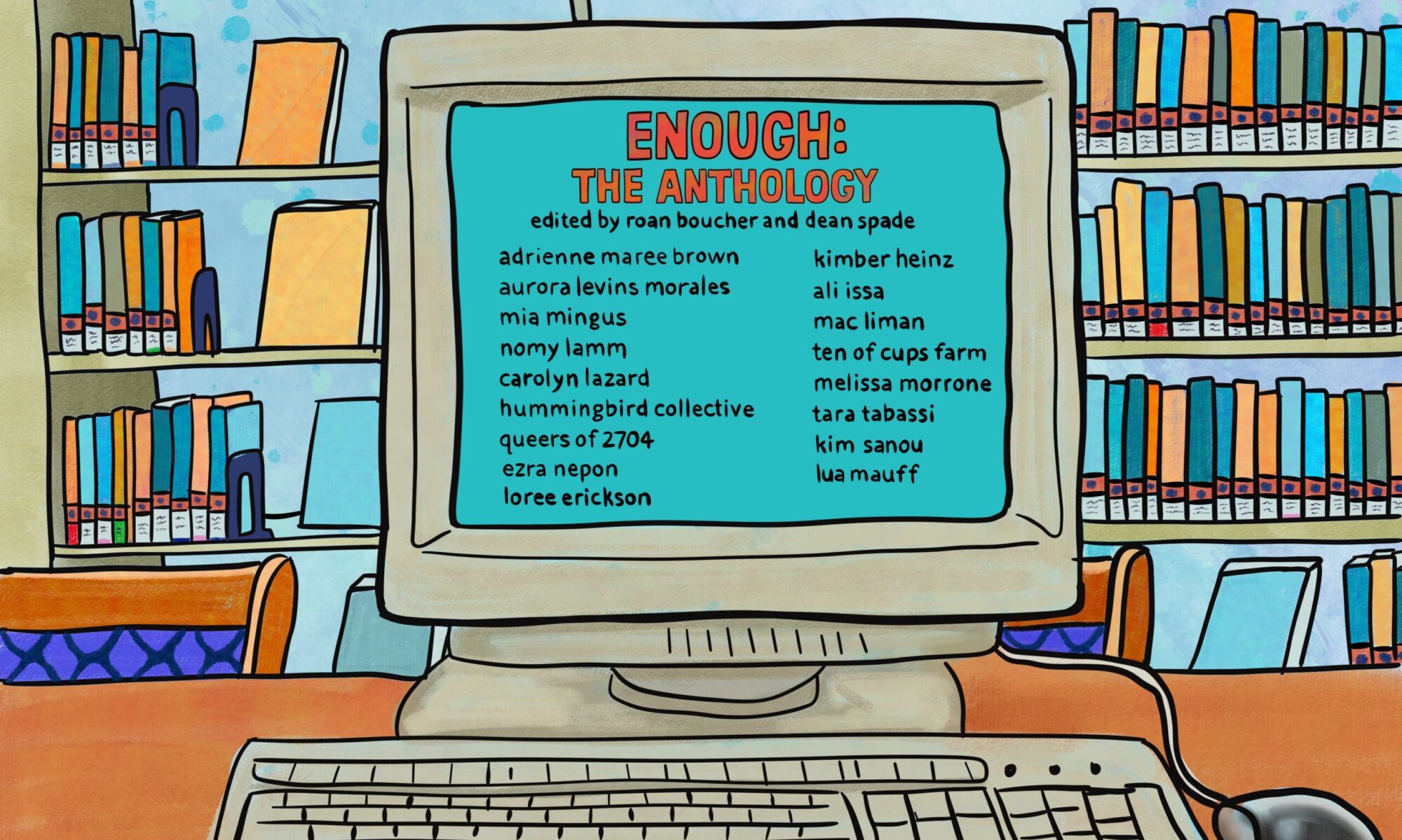
Mia Mingus, 2015
“Look closely at the present you are constructing:
it should look like the future you are dreaming.”
-Alice Walker
Interdependence
When I think about the meeting place of TJ and resisting capitalism, I most often think of our work to build interdependent relationships and communities that can respond to all types of violence, including the violence of capitalism. I think of the need to push back against a culture of independence and the myth of independence that tells us that we can and should be able to do everything on our own—that we shouldn’t ask for help—and the way this thinking foils so many of our best attempts at liberatory work.
The work I am most interested in to resist capitalism is not only the vital work of redistributing money and resources or the structural and institutional political changes we need to make, but the changes we need within our intimate networks and communities as well. The kind of relationships, interdependence, and commitment we will need to build with each other that will allow us to sustain our work to resist, divest from, and ultimately build compelling and viable alternatives to capitalism.
The intentional damage that capitalism has done to our relationships, trust, commitments and love are profound and I often wonder how we will be able to build back all capitalism has taken from us. What will we need to begin to slow its generational effects?
For most of us who have experienced violence within our communities, it is not only that we cannot turn to the state, but it is also that most of us do not have people in our lives to whom we can turn to for support, let alone a TJ process. This is particularly true in instances of domestic violence, rape, sexual assault, child abuse and child sexual abuse; as well as for survivors, as well as bystanders and those who have harmed who want to take accountability.
Capitalism relies on the breaking of relationships and isolation. It thrives every time we turn away from each other and even ourselves. It insidiously breeds distrust, competition, domination, fear and shame for the sake of profit and greed. Capitalism conspires with abled supremacy to mercilessly shame and guilt us for need, rest and care. Our bodies’ worth becomes measured by our productivity. Our time gets monopolized by the exhausting and dehumanizing work of survival rather than care for and connection to ourselves, our loved ones and the planet. We internalize the myth of independence. Therefore, when violence happens, we often do not have the capacity, time or social ties necessary to be able to respond well, if at all.
Because the truth is, our communities are not perfect either and there is much transformation needed to be done inside of our communities as well. For many of us, attempts at transformative justice and community accountability painfully reveal just how much work we need to do on the “community” part of “community-based responses to violence.” TJ continues to expose how few of us feel connected to a “community” and how, though we continually throw the word around, many of us don’t know what “community” means, even as we desperately long for it. Those of us working to respond to domestic and sexual violence within our communities realize quickly that much of our work must include building relationships that have the capacity to support TJ responses.
Part of building interdependence is about cultivating a kind of commitment that is extremely rare. I have found it looks like knowing that we will make mistakes and mess up, and that our challenges and spectacular failures will far outweigh our victories and successes. Our commitment must be to keep learning, changing and trying, because if we are to ever find a way out of the cycles of intimate and state violence, trauma, and exploitation that surround us, we must become well-practiced in growth, repair and courage. It is a commitment to each other that we cannot do this work alone and that we need each other. We need each other. It is rejecting the individualism of capitalism that tells us that we are better off alone, not to trust, and that our “safety” means someone else’s exploitation and oppression. It is building connection as a challenge to isolation and countering disposability through creating the conditions that could support healing, redemption, making amends, and accountability. It is moving away from binaries such as good vs. bad or guilty vs. innocent by acknowledging our complexities, contradictions, and collective responsibility for violence. It is doing the work to take care of ourselves so that we can take care of each other, and vice versa. It is being able to have and express our individual and collective boundaries, and doing the work to even know what our boundaries are. It has looked like collective leadership and vulnerability, humility and gratitude.
I believe, at the heart of our work for liberation is the place where responsibility and choice meet. It brings to mind the kind of commitment that keeps children fed despite exhausted parents, the selfless things we do for the people we love or the centuries-old, unyielding, determined tide of justice. The sacred power of purposeful and choice-full obligation and willing responsibility that are not forced, but instead desired, honored, and valued. This is the kind of interdependence that I am always looking for and that I never want us to lose ever again. This is the kind of interdependence that I believe is liberation in practice.
Transformative Justice
Transformative Justice is a generative methodology for addressing harm and violence in ways that support survivors’ healing, harmers’ accountability, and community well-being, without relying on existing punishment systems. TJ seeks to address incidences of harm and violence in ways that meet immediate needs, while transforming the conditions which allow for harm and violence to occur.
We understand state systems such as prisons, police, the criminal legal system, border patrol, and the foster care system to be entities of extraordinary violence, cruelty and punishment. Because of this, TJ responses do not rely on the state. We know that state systems do not hold the monopoly on punishment and violence and that many, many survivors have experienced incredible trauma within their community and intimate relationships in the form of victim blaming, minimization and denial, shaming, exile and ostracization, threats, verbal and emotional abuse, or full-blown violence. TJ compels us to do the hugely challenging work of recognizing, understanding and ultimately rejecting punishment, no matter its form or source.
TJ is a collective response to violence and lives under the umbrella of “community-based responses to violence.” It reminds us that violence and harm have collective impact and therefore necessitate collective responses, rather than the traditional individual-heavy responses that we are sold. Repeatedly, we are told that justice equals an individual court settlement or individual punishment or healing. Instead, TJ works to create collective responses that go beyond only those directly involved in the violence (i.e. survivor(s) and the person/people who were violent or harmful) and include bystanders, people who have relationship to those directly involved in the violence, as well as the broader community.
TJ works to meet immediate needs of current incidences of violence in ways that support our long-term visions for community and liberation. For example, if we understand that prisons are violent and oppressive and our vision for liberation includes abolishing prisons, then our current responses would strive to not perpetuate and reinforce the prison industrial complex. TJ seeks to connect incidents of violence (e.g. rape, physical abuse, robbery, police brutality, child sexual abuse) with the conditions that create and perpetuate them (e.g. patriarchy, transmisogyny, poverty, global capitalism, white supremacy, ableism, ownership of children and land). TJ works to respond to violence in ways that transform the conditions that allowed for the harm and violence to happen in the first place.
Transformative justice recognizes that violence doesn’t exist in a vacuum. There is a context within which violence happens and there are conditions that create and perpetuate violence. It does not mean that individuals should not be accountable for their behaviors or the harm they cause, but we must build our capacity to simultaneously hold individual and collective responsibility and accountability with nuance, wisdom and curiosity. The same can be true for preventing and stopping violence. We have a collective responsibility to prevent and stop violence. We can also identify, create, and support the kinds of conditions that can support our interventions to violence and hopefully prevent violence from happening all together. We can work to collectively cultivate conditions such as connection, transparency, sustainability, community, trust, belonging, taking accountability, healing, de-escalation and direct communication. Our work is not only to respond to current incidents of violence without relying on punishment and harm, but also to work to prevent violence and transform our relationships, families and communities. We are not only resisting what we don’t want, we are also working to build the kind of world we ultimately long for and dream of.
TJ is both response and prevention: How can we respond to violence in a way that both meets immediate needs and simultaneously works to prevent future incidences of violence from happening? TJ is ‘what is’ and ‘what could be’; everything we have always known and everything we need to learn. What I mean is that TJ is simultaneously incredibly simple and incredibly complex. TJ is both pragmatic and visionary, not sacrificing one for the other. At its best, I have seen TJ be organic, accessible, and born out of the very conditions it seeks to grow.
Our communities have been trying to respond to harm in ways that do not create more harm for generations, even if we did not call it TJ. Many of us can probably recall stories from our own lives of how we responded to violence within our families and communities. And for many of us, calling the police has never been an option—because the police are likely to inflict more or greater harm—so we have been trying to patch together responses for as long as we can remember.
Capitalism is inherently violent and abusive and as such, all work to challenge capitalism is an intervention to violence. Work to transform violence is anti-capitalist and anti-capitalist efforts are necessarily practices of TJ. Violence is a cornerstone of capitalism. The violence of capitalism and the ways that capitalism necessarily uses violence to maintain and expand its power are deeply intertwined and at times indistinguishable. In addition, capitalism normalizes exploitation and lack of consent, setting the state for harm and violence.
Violence and abuse not only serve to reinforce the culture and conditions of capitalism, but they continue to be hugely profitable and necessary markets themselves: war and surveillance, militarization, hate violence, child abuse, human trafficking, murder, torture and prisons—none of which are mutually exclusive. Beyond profit, state systems such as prisons, police, the criminal legal system, the medical industrial complex, and the foster care system rely on violence and are sites of violence themselves whether physical, emotional, psychological and/or sexual; the breaking of connection and relationships; displacement and isolation; or commodification and dehumanization. State responses to violence often take the form of social control aimed at targeting oppressed communities, such as poor communities, communities of color, disabled, undocumented and/or trans communities under the guise of “safety,” “protection,” “rescue,” and “cure.”
Anyone who has been involved in TJ work has felt how capitalism (and the trauma it causes) has threatened and hindered our responses to violence. This work directly challenges the culture of capitalism at every level. It challenges a capitalist culture that tells us that we are ultimately disposable and only worth as much as we can produce or the resources that can be exploited from our bodies; that tells us that violence and abuse are profitable and necessary, and that independence, disconnection, and isolation are admirable ways to live.
Transformative Justice is an anti-capitalist practice. This is not only because cycles of violence and the trauma they produce are highly profitable, useful and necessary under capitalism, but also because these cycles undermine our best attempts to fight for a more just world. How can we fight against gentrification, if our anti-gentrification coalition is irrevocably fractured because we didn’t know how to handle conflict? Or because we chose not to deal with the sexual assault that happened within the coalition? What good is winning a major campaign if relationships are so badly damaged that no one wants to work together again? Our inability to effectively respond to harm and violence—and even conflict and misunderstandings—continue to plague our efforts to grow the kinds of relationships we need for all liberatory work.
TJ challenges us to find creative solutions and strategies that do not replicate a capitalist culture of distrust, domination, violence, oppression and exploitation. It means building responses to violence within our communities that do not rely on the state and actively cultivate the very things that we know will prevent violence such as accountability, safety and healing. It means growing the conditions that can support TJ.
TJ is grounded in relationships. If we do not have strong relationships with each other, if we are not connected in meaningful ways, we will not be able to effectively transform or prevent harm. We are up against a heavily documented epidemic of loneliness, a crisis of belonging and generations of unhealed trauma. Organizers carry their pain and trauma with them to every meeting, zoom call, conference, coalition, campaign and into every relationship they are a part of. We act as if the only “real work” is organizing a protest or mutual aid campaign, direct action or strategy session and then wonder why so much of our “real work” continues to fall apart.
To end capitalism, we must be able to respond to harm, violence and abuse within our communities. We must stop outsourcing this work to systems and cultures wedded to punishment and criminalization that profit off our pain and trauma. Just as we would work to create community-owned and run housing, food and education, we must also work to build the individual and collective skills and practices to support healing, growth, accountability and repair.
Pods
One of the most effective ways to build our relationships within TJ is to build pods. A pod is a tool to address and prevent harm, violence, emergency or crisis. Pods can be used to address specific needs and aid in general support. Pods are made up of the people in our lives we can rely on and turn to first. When we are referring to pods in the context of TJ we are often talking about harm and violence, both how to respond in real time or after the fact, as well as how to prevent or plan for when harm may occur. However, pods can be used in a myriad of different contexts, far beyond acute harm and violence. And it should be noted that even though there may not be acute harm, the mere use of pods and their wide dissemination into many aspects of our lives helps to create the conditions that can lessen both the impact of harm and the likelihood that harm will happen in the first place. Pods are a simple concept with an endless amount of uses and applications. Pods are a way to make words such as “community” and “support” more concrete and pragmatic.
Mapping our pods forces us to get clear about what kinds of relationships we have in our lives and what kinds of relationships we want and need in our lives to practice TJ. It allows us to reflect on why we don’t have more authentic relationships in our lives and how we can change that. It helps us begin to think about what skills and capacities our pod has and what skills we need to build.
Pods are one of the few everyday tools that is an explicit practice and condition of TJ. Pods are essential for accountability and healing because both are most effective when they happen in relationship with others. Pods help us to identify and create the people and relationships within which accountability and healing could take place. In an age where very few people feel like they belong and far too many live isolated from authentic relationships, let alone ones that could offer care, the act of building pods in and of itself has the power to transform.
Building our pods is a concrete way to prepare and build resources for transformative justice in our communities. Building pods is also a way to practice and cultivate liberation through values such as care, support, healing, accountability, community, love, interdependence, repair, belonging, trust, courage and possibility. Pods invites us into a more connected way of living that resists isolation, fear and hopelessness, some of the many factors that allow for harm to occur. If everyone had a pod, imagine how much more resourced and supported we would all be. Imagine how much more accountable and brave we might attempt to be. Imagine what could be possible inside of our communities, neighborhoods, cities and movements for justice.
Building New Worlds
The work of TJ is to not only resist capitalism and other oppressive systems, but to also build new kinds of relationships, communities and worlds for all of us. TJ asks us to imagine what a world without state and interpersonal violence would look and feel like. A world where we lovingly and committedly care for each other and ourselves; where rape and torture are understood as historical forms of violence; and where people proactively take responsibility to change their actions, instead of waiting to be “held accountable.”
Most of us come to transformative justice before we realize how much we don’t know. It is humbling work. Many of us come to this work out of frustration about what we have, or rather what we don’t have, and what we so desperately need and want to create. For many of us, this work reflects the things we already knew and did in our own lives, even before we knew about “TJ.” Some of us accidentally find the work through a wrong turn or a way home. Others seek it out, hungrily scanning the horizon for the faint glow of a lighthouse and once ashore, never set sail again.
However we come to the work of transformative justice, even if we do not stay, even if we end up burnt or bruised or more heartbroken than when we began, one thing is certain: there is a moment of hope. Even if it is small, even if it fades, there is a moment of hope for the compelling, sometimes nagging, possibility of community accountability and transformative justice. A moment that pulls us in—all of us—even those of us who have only been tangentially involved in a response. A moment that taps into our grief and longing for the mere possibility of creating something different than more cruelty and more trauma. Something that could be healing, something that could be transformative. A glimmer of green pushing up through the concrete. It is in those moments where some of our greatest potential lives.
Fundamentally, TJ hinges on our ability to imagine a different future for ourselves and our communities. Whether it is the possibility of healing, the ache for a world where no one ever fears being sexually assaulted, the dream of loving and respectful relationships, or even just the hazy stubborn determination that one day we will break generational cycles of abuse. In order to engage in TJ work we must develop and strengthen what we believe is possible of ourselves, our communities, and the world. We must believe that there can be a different way beyond the usual binaries of guilt and innocence filled with shame and blame, punishment and revenge, oppression and exploitation, isolation and disposability, trauma, fear, and the breaking of relationship. We must believe in repair, reconciliation, and transformation. We must believe that we can come back from the hard, painful and harmful. Capitalism relies on our complacency and our acceptance of the crumbs. The very act of dreaming and not just fighting against something, but building what we believe is possible continues to anchor our work. We are practicing new ways of being that allow us to be more human, not less. We are growing new paths of freedom, healing and love. We are building the futures we are dreaming.
Mia Mingus is a writer, educator and trainer for transformative justice and disability justice. She is a queer physically disabled korean transracial and transnational adoptee raised in the Caribbean. She works for community, interdependence and home for all of us, not just some of us, and longs for a world where disabled children can live free of violence, with dignity and love. As her work for liberation evolves and deepens, her roots remain firmly planted in ending sexual violence.