Queers of 2704, 2012
Between May 2006 and August 2010, a peculiar sort of amorous endeavor took shape in the Mission District of San Francisco. An urban, modern-day “commune” existed where the residents shared everything. Literally, everything! Beds, meals, showers, relations, rooms, material items, experiences, love, food, closets, friends, politics, projects and dreams – but not underwear drawers.
“We were queer, poly, and kinky. We were young and hot, we were wild and crazy – in the good and hard ways. We were political, we were lovers, we were sister-brother, we were each other. We were 2704. At one time – that qpoc house – it was awesome, and like all good things, it ended.”
The following is a brief, retrospective account of our times as a “commune” – a word others often used to describe our living arrangement. We write to share our version of making queer homo love because this undertaking has furthered our individual and collective healing from the alienation and dehumanization, those toxic by-products of the current exploitative economic system and present legacies of Empire and colonization.
Capitalism is an economic system that bases itself upon power-over relations of domination and habituates us to complicity with the system in our most intimate settings – reproducing within ourselves a mind-over-everything mentality; over-body, -heart, -will, -speech, -desire. These dynamics influence how we relate to everyone and everything around us. It felt good to build our home as a refuge from the hierarchical, rigid world we experienced in our daily lives.
Butch(er) Paper Beginnings
In early 2006 over a shared meal, six people explored our desire to live in the expensive city of San Francisco, California. We were in our early 20s (20-25), some of us were students, some of us had full-time jobs; some of us were queer-identified, anti-authoritarian; all but one of us identified as people of color. Some of us were already related to one another as friends, lovers, and siblings; some of us were beginning our relationship as housemates, though we had known of each other through extended networks. Some of us were already living in SF, some of us were not.
In that first meeting we set intentions, discussed our financial limitations which raised questions about what may be possible. We figured that between the six of us, we could afford a place in the range of $400-500 each for rent ($2400-3000/month) and hoped against all odds to stay (for those of us already in SF) in the Mission District. If rent seems high, it’s because it was – San Francisco had and continues to have some of the highest rents in the country. A quick online housing search revealed that there were some options in that price range available, however, the best options turned up four-bedroom houses and apartments only. There were no 6-bedroom rentals in our price range.
How would we share 4-bedrooms among six of us? We didn’t want to reproduce what we’d seen with shared housing in the city – a house full of individual bedrooms that were private havens unto themselves, with refrigerators and cupboards cut up into sections that divided deliciousness by resident, and with very little (if any) common space. We wanted to have more rather than less, and together we had lots of everything to share. Most of us had previous experience in sharing housing; whether in college or growing up, many of us had shared living quarters with people beyond the hypothetical nuclear family – though, that could hardly prepare us for the living arrangements we were about to envision for ourselves.
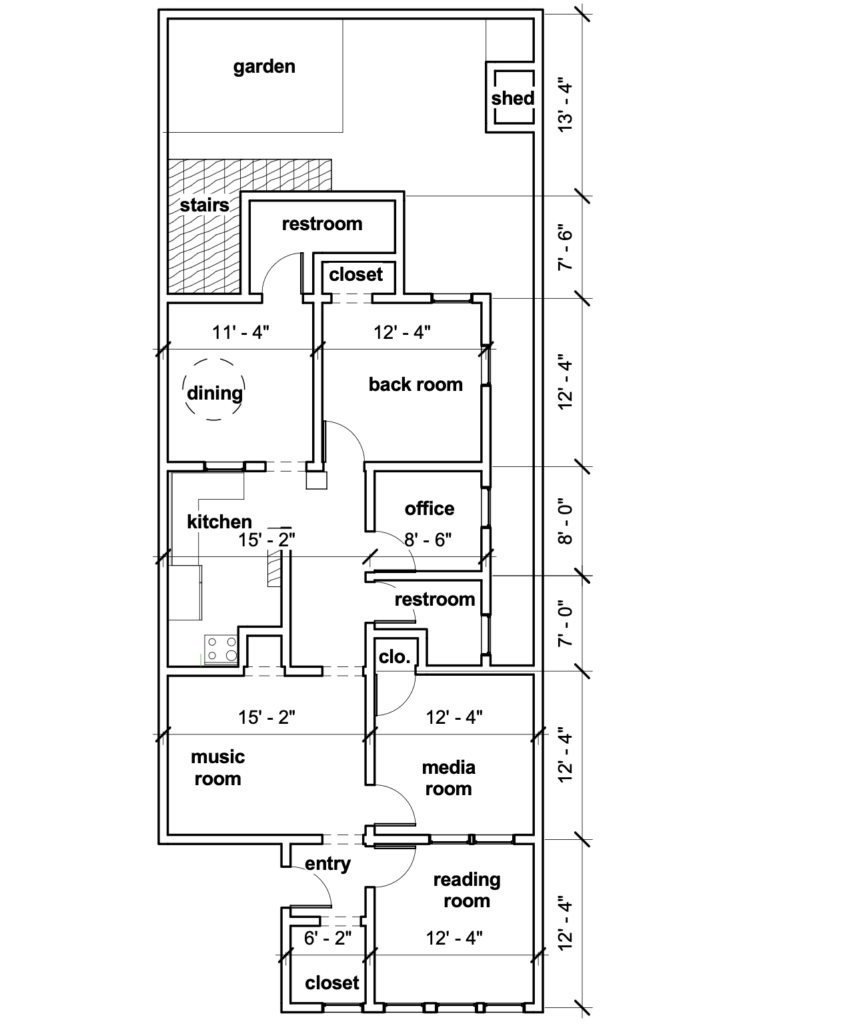
Somehow from our collective brain we came up with the idea of putting a bed – or two – in every room to ensure everyone had a sleeping space. Instead of assigning people to individual bedrooms, we agreed to assign themes to each room and distribute our possessions throughout the house based on the ideal purpose of the room. We envisioned having a reading room, a media room, a music room, an office, a lounge, a dining room (no bed), kitchen (no bed). Our thinking was that in the day-time, those rooms would function as common space and in the evening, turn into bedrooms. We envisioned sleeping in the room that suited us that night, with each of us doing our best at rotating rooms and requesting them for “special” time (for example: sexy, sickness, and/or study time).
The commitment to make the spaces dual-purposed, meant a collective willingness to pick up after ourselves, so that the space could serve its dual purpose. The commitment to assigning themes to each room meant a willingness to figure out sleeping arrangements every night and to make all the sleeping spaces desirable – since you may end up there for the night. Yes, it was an intimate proposal from the start! This was not like anything any of us had ever done before, but somehow, we thought it was possible – it looked doable on the butcher paper we’d mapped out for ourselves. Instead of having one bedroom and maybe a dining room to share, we gave ourselves five open rooms to exist within and share. It just made sense to us at the time, so we decided to go for it.
[see diagram of our house, with names of rooms, at the end of this article]
We moved our boxes and visions into our home on May 1st, 2006, and set about making our intentions a reality. Many of our friends, while curious, were waiting for the other shoe to drop, for our “experiment” to implode. As the house began to take shape, and the months turned to years, the doubts and mockery shifted to hope and appreciation for the home we shared with each other and our network of friends and loved ones. We had an open (unlocked) door policy until we disbanded in September 2010. Literally, we kept the door unlocked day-after-day, in case a weary soul just needed a place to rest.
We wanted our loved ones to have a place to stop in for a friendly chat, to use the bathroom or drink some water, get a snack or have a smoke, share a song, laugh, or dance. We wanted to offer a safe(r) space from what we felt was/is the madness of the world outside of our door, the lived ‘isms‘ we experienced and resisted every day. It was the world we wanted to live, so we made it so. And yes, that did mean that two strangers, and even a disgruntled lover, came into our home unwelcomed, and for a few weeks following those separate incidents, we all had to reflect and reconsider our open-door policy. After the feelings of violation subsided, we found ourselves recommitted to leaving the door open once more.
“I could never do that!”
Of the original six founding members of the house, three of us were siblings, one of those siblings was partnered with another housemate, and the last two were friends with both of the partnered housemates. This formation didn’t hold for long, and during the four years we operated as a “commune” we had about seven additional residents join us, sometimes filling vacancies and at other times increasing our numbers. We maxed out our occupancy at nine residents and a small dog, and on the other end we dwindled down to five.
Some have speculated that the pre-existing relationships are what made the house work. Others viewed it as further proof of the exceptionalism of our character – since in their own estimation, those types of pre-existing relations would make it even more difficult to share such intimate arrangements. What stands out to us as a more relevant factor is that we made a commitment to make a home with one another – and for us, that meant a commitment to figure it out together.
It was a haphazard first few months: the contents of our future shared closet were at the time in black garbage bags on the floor and a household budget was non-existent. Housemates took individual initiative to bring into our home needed food and furniture, cooking, cleaning and giving order to our many varied possessions – all while continuing with school and/or work.
In the following months, we designed and built the shelving inside the Get-Ready Room – the house’s smallest room turned walk-in closet. We integrated and organized all our clothes by type of clothing, though we always retained separate underwear drawers. As we integrated and distributed our possessions throughout the house, we did so with the idea that everything would have a place and so could be put away, including a single, “private” drawer in a tall bureau for those things that were yours that one needed to keep separately. We also lofted a couple of the beds in the different rooms to make more space.
One housemate encouraged us to keep track of who paid for what and when, and as we continued to live together these details were shaped into a budget proposal. The proposal of $700/month was inclusive of rent ($2600), trash ($25), internet ($75), groceries & bulk ($700), laundry ($100), cannabis ($300), household items ($100), car expenses ($200) and party supplies ($100) – all items we deemed essential for our child-less household of fairly able-bodied, 20-something year olds! That meant on average, we each were paying $435 per month to live in one of the most expensive cities in the country – and with an additional $275 for a shared board bill, we were living more comfortably on less than if we weren’t sharing resources in this way.
Over time, we agreed that groceries meant no ready-made-food, but ingredients of all sorts. The proposal was adopted over dinner as a monthly guideline for how we’d spend our shared money. Two other housemates went to our local credit union and set up an account with all of our names on it. With that everyone in the house was enabled to make financial decisions on an as needed basis and ideally within the guidelines we’d suggested for ourselves. In practice, that’s what happened.
In retrospect, we realize there was indeed a lot of trust and generosity of spirit, because we failed often at simple things like feeding ourselves well, especially in the beginning. Being stubborn anti-authoritarians, no one wanted a chore wheel – and so we never had one; we even refused to have an assigned cook night. In this way, we tried to make room for us to contribute individually as we felt moved to do so – and as we contributed, we were given feedback about our contributions in real-time:
“Oh, that’s too spicy for me!” “And they don’t eat soy.”
“I really like this sweater, so if you’re going to wear it, it goes in the delicate wash.”
“The cast-iron pan is never washed with soap.”
And as we didn’t mind each other, we were also given feedback:
“I just cleaned up that room, ‘cause I’m having someone over.”
“I made dinner last night, and am not putting away leftovers y’all!” “You can’t park the car in the driveway!” “Why are you screaming?”
“I was in the middle of something, not now.”
Not having assigned tasks did mean that, at different times, some people contributed “more” than others. Our general sentiment was that this was okay because we understood life threw challenges and excitement at us at different times, and so at other times those same people perhaps may contribute “less”. Sometimes we called our home a “do-ocracy”, do what you see was necessary. Some people really liked cooking, and did lots of it. Some preferred to keep bathrooms clean, others the floor and other people really prioritized laundry or taking out the trash, compost and recycling.
We were all really good scavengers also, and through the students, worksites and our neighborhoods – we regularly stocked up on food and other essentials after events, rummaging through free boxes, garbage bins and finding things on the streets. For one housemate’s graduation, we – as blood and chosen family! – hit the dumpsters in between ceremony and reception. A shopping trip to the store may simply be for the things one needed or one could let others know and pick up items for people. We bought certain things in bulk to save money, namely toilet paper, paper towels and detergent.
As we continued to get to know each other, our rhythms, likes and dislikes – from food allergies and preferences, pet peeves, bathroom habits, hobbies, style of communicating, etc. – we would all help each other take note (in person, over phone, text or email). When the space felt consistently disheveled, we’d initiate the on-and-off again “Pick up after yourself!” campaign or schedule a day where we’d all collectively clean the house for a few hours. We were especially good at the collective clean in preparation for a party, which we hosted every couple of months. We managed to have very few scheduled meetings because we enjoyed spending time together and so, we shared ideas and feelings regularly – in person, over text, phone and email.
Money, growing and the politics of emotions
Figuring it out together meant we were committed to breaking down the barriers to talk openly about money. At 2704, we strove to be open with one another with what can sometimes feel like a loaded subject or a subject some of us had learned to keep private and secret. At times we adjusted if one of us was short, sometimes paying only the rent portion but not the board part of the monthly contribution – but this meant we had to be transparent about our financial situations and be willing to discuss our needs and wants. Some of us adjusted our contributions because we had financial resources available to us by way of unexpected financial or material support from parents.
At times it went poorly. Like the time a housemate who asked to have their lover move in failed to disclose said lover would not be able to (or did not plan to) pay rent. This detail was made known only when this cisgender man was already en route from the UK. This felt manipulative to some, but we did our best to figure it out, and agreed that work could be done around the house in exchange for room and board. The work didn’t materialize as discussed – probably because he was not involved in the discussion. It was a trying few months, and after a particularly difficult house meeting, they both moved out.
During that difficult house meeting, the housemate who brought in said lover, a woman of color, insisted that the lover was “unable [or unwilling] to pay rent because he hadn’t paid rent in the squat he had lived in the UK”, and further he was “unauthorized to work in the country.” Tempers flared amongst some of the other residents, who loudly cried foul at the faulty reasoning that in essence burdened all of us with the upkeep of a white dude from Europe. Not all felt this way, noticeably the other cisgender men in the home, who said little during that meeting or after they moved out. The tensions lingered in the relations of those of us who remained.
Then there was the time later that year when a month-long guest turned into an 8-month “guest” who wouldn’t leave and did not contribute as the housemate he’d informally become. This was a college friend of one of our housemates, and he spent his 8-month stay mostly playing guitar and doing drugs – neither things we begrudged him. Rather, the problem was that he did little in terms of contributing or building up the space. He seemed pretty unable or unwilling to integrate any feedback he got from us, and he eventually moved out on his own accord… though not before testing our willingness to let him stay without paying rent, because “he didn’t have the money.” Luckily, he left soon thereafter. He was never welcomed back into the space and our concurrence of “good riddance!” seemed to bring those of us who remained closer together.
And sometimes it worked really well. Like when we moved in one housemate who was unable to pay the full rent right away because he would not be paid until after he had moved in. We happily fronted the money and he promptly repaid it, and eventually finished paying into the deposit. Or the time when one housemate’s mom needed money for surgery, and we threw a party that raised a few hundred dollars to send to her. Or the time when we were beginning to plan our house “gaycation” since we had accumulated a good safety net, but instead forwent the fun to pay for an expensive house emergency. Or at times when some of us were tight one month, maybe we wouldn’t pay all of the board bill … the key was really communication, and our commitment to care for and believe in each other.
In retrospect, it’s easier to be a little in awe of ourselves – we were so young, and some of us both so hurt and resilient, growing emotionally into magnificent people for whom we had no mold.
“Oh, you live in that queer commune!”
In mid-2008, with the departure of two founding cisgender male housemates, one of them white – the space became explicitly a queer people of color house. After two years of living together, and doing queer political organizing together, those of us who remained were better able to articulate why it was important to have a queer, POC-only space in our home. To be clear, the proposal was ‘queer’ from the start – in that it was an odd living arrangement, in that most of us had queer desires, identities and practices. And an intention for a safe(r) space for people of color was also there from the start. In fact, the decision to include the one white founding housemate was almost blocked by another founding housemate: “I’m not living with white people.” But then they met, and shared anti-authoritarian, anti-racist analysis and the block turned to a stand-aside.
Some readers may wonder, why is it important to have a queer, people of color space? For us as queer people of color, stepping out of our home to go to our workplaces, to most public spaces, to queer events, in San Francisco, meant we were often awash in a sea of heteronormativity and in many queer spaces, whiteness. As im/migrants, most of us were not too put off by the sense of not belonging to the outside world, we were quite practiced at it; but as im/migrants we also longed to belong, to feel at ease, and so we poured ourselves into our homo.
By this time, we had many sharing practices structured into our lives and ways of living that served us well in making our home feel supportive, beautiful, welcoming. At this time people’s responses to our home were gratitude, excitement and curiosity: “So this is what it would be like after the revolution!” exclaimed one guest. Friends and acquaintances responded with hope, appreciation, participation and contribution instead of skepticism. Together, we created fabulous parties like The Fall Menagerie Ball, A Lace & Leather Affair, Let Your Inner She-Wolf Out, Queer Wrestling Party… and oh, the outfits!!!
We also had many dinners, workshops, meetings, and work days. We fucked all over the house, with each other, with our friends, lovers and guests. We hosted many queers on the road from far and near, and we hosted some of our many blood relatives, too. We also dealt with and failed at effectively addressing difficult relationship dynamics between siblings, housemates and their respective lover(s), and between housemates. And then there were bedbugs.
All good things…
Being a sex-positive household that shared such intimate living arrangements meant we were used to discussing our health concerns with each other, whether it was a cold, scabies or our STIs – so we could take necessary precautions to stay as healthy and safe as we could. Bedbugs was a public health risk we knew we exposed ourselves to due to the large numbers of travelers we hosted, and when we began noticing bites we hoped against all odds that it was aggressive spiders – yeah, there’s no such thing. After a few weeks of collective denial, we finally found an actual bug and then tried all sorts of non-toxic solutions on our own, without success.
Prior to fumigation we had to rid ourselves of anything that could not be fumigated or washed and dried on hot settings, and wash and/or store the rest of our belongings. The coordination was an expensive, time-consuming, energy-draining ordeal and we felt fortunate that we had accumulated “savings” from the monthly surpluses of previous months to offset the cost of fumigation preparations (California law states the landowner must pay for the fumigation itself). Among the losses were many dearly-loved possessions, weeks of being unable to live in our home, and our savings that we were hoping to use for a house trip. And the point here again is that even when it was difficult, we did our best to figure it out together.
In the spring of 2010, 2704 was hit with another bout of bedbugs. So much more was lost – again! In its wake, two housemates announced their imminent and staggered departures. In August 2010, with three housemates down – one more backed out and in the following month, 2704 family-style living was over. It was a swift and sharp transition from five, dual-purpose rooms – a reading room, music room, a media room, an office, a lounge space – into a four-bedroom house, with a shared living room. The contrast was stark. 2704 remained a queer house for a couple of years, and finally shut its doors in August 2012.
What We’ve Taken With Us
So was it just a phase? Well, yes, of course it was; and no, it wasn’t just a phase. We made different choices than most 20-somethings we knew about how we wanted to live and make our home. Like our queerness, it was and is hard for some people in our lives to respect our choices to be as we want to be, not as we are expected to be. Choosing to live out our resistance to capitalism via our practice of autonomy and interdependence at 2704 demanded a healthy dose of self-responsibility from all of us. And we were rewarded with material resources and emotional experiences that could have only arisen from sharing the intimacies of our lives.
Looking back, it’s easy to see how we all were challenged to grow emotionally and politically. The challenges we faced and mistakes we made were integral to our learning. If we had to do it over, we’d do it again – and we’d pay more attention to strengthening the emotional infrastructure needed for such a project. Some of us have dreamt of sharing a household with children, a home that can welcome our elders, a space where we can age meaningfully with all of our loved ones… but for now, we’ve yet to pull out the butcher paper.
Li Morales and tootles Lee are sister-brothers of womb and fierce co-conspirators in life. They worked on this piece while in dialogue with, and with input from former, current and future housemates – Vivian, Abel Diego and Essex. We’re most titillated by our guest who observed that “if you weren’t queer before you walked in, you certainly left a little bit queer after.” We are forever grateful to all of you who have made and continue to make queer homo love real in this lifetime – thank you 😉