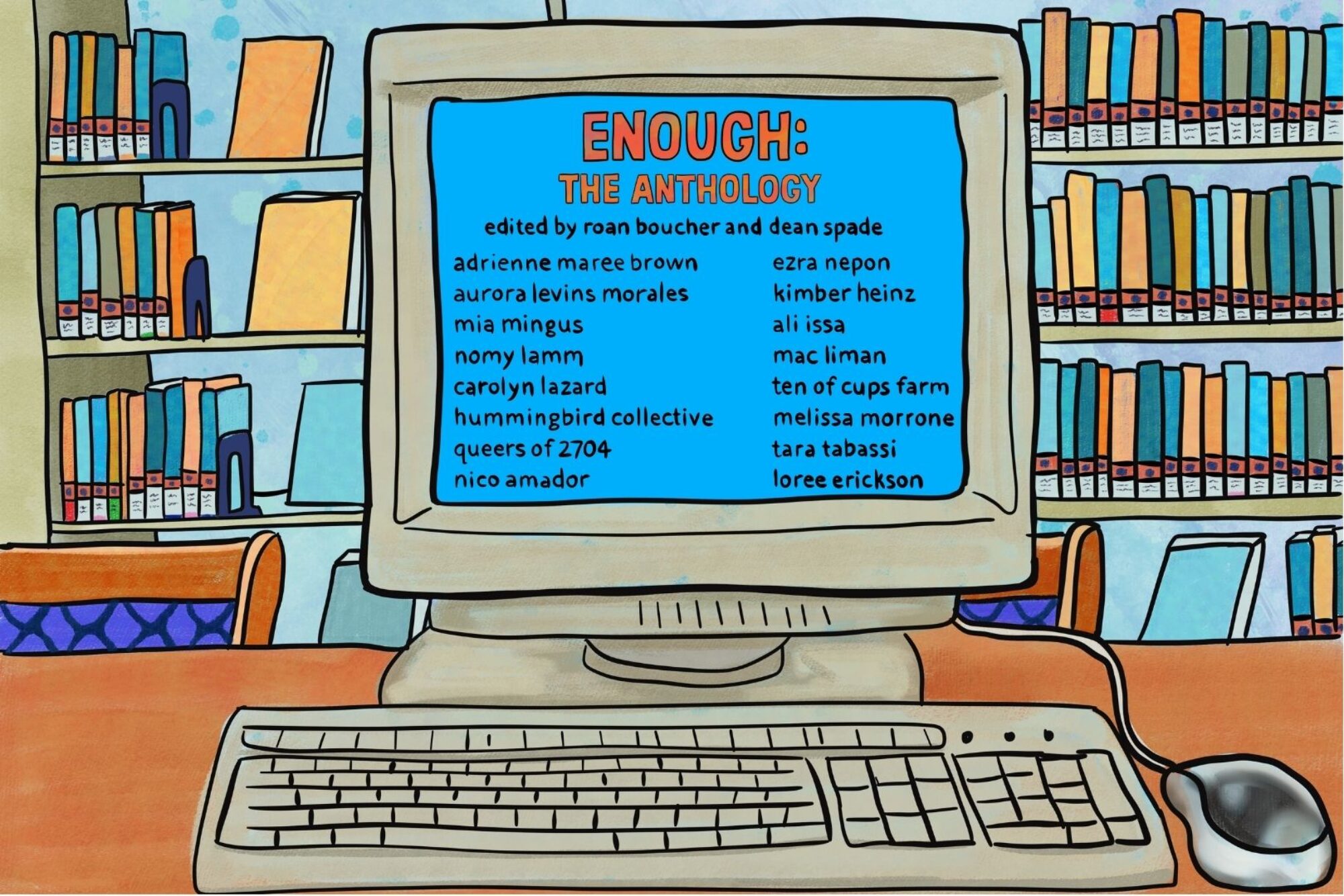
I recorded this conversation with Dean in May of 2018. Since then, so much has happened personally and politically, as if those two things are ever separate. A week after this interview my mom passed away — kind of unexpectedly, kind of not. She was living in a state-funded long-term care facility in Virginia and died of complications due to pressure sores, one of the many deadly consequences of institutional care that is not actually caring. Just under 2 years later, with the pandemic, we were given a massive-scale picture of what happens when as a society we don’t care about care. What happens when systems of power and certain individuals are working hard to deny our interdependence with one another and with more-than-human life like the land, air, and water. During these times, we also see moments and movements of resistance. Communities coming together and practising cultivating and creating caring worlds for all of us, not just some of us. There is so much I want to say about COVID and the ways it impacted my care collective, and important lessons about the relationship between care and liberation that I don’t have the capacity to say here. In the interview, I talk about how thanks to my care collective, I have all these beautiful little moments in the bathroom to draw on. During the height of the pandemic when everyone in the collective was stressed out, scared and struggling to figure out how to get through this hard time together, we were deeply appreciative of the care collective. Care shifts were a space for connection and intimacy, laughter and comfort.
I go into more detail in my interview, but I started my care collective in 1999 in Richmond, Virginia with a few of my closest friends because of the combination of bureaucratic confines around care funding structures and the limitations of institutional care. These issues persist and in many ways are worsening. Skyrocketing costs of living, lack of accessible affordable housing, and a gutting of social services all lead to people not getting what they need to survive. Over the years I have met with many people to help them start their own care collectives. I started my website cultivatingcollectivecare.com to provide a community hub for folks wanting to share questions and strategies around navigating these difficulties. One example that really stood out to me was a person in Montréal who needed to create support because the care systems they had in place were on a rigid time schedule and if their paratransit was late (and they so often are) the person would have to choose between going to the washroom and eating dinner.
When I moved to Canada, I wasn’t eligible for any government support because I wasn’t a permanent resident or citizen. The Canadian immigration system, like all immigration systems, is built upon colonialist, racist, classist and disableist notions of who is a desirable citizen. After many years and so many hoops and struggles I got permanent residency. I decided to pursue the government funding support for care to supplement and support care collective members who were really struggling financially. It was my hope that Direct Funding would be a resource to support folks who were supporting me. I had to wait 2 ½ years on the waiting list and then undergo an arduous interview that lasted 4 ½ hours to prove that I have the capacity to manage and direct my care.
In theory the goal of this program is to allow folks with disabilities to have control over their care. A part of this interview included an assessment of my care needs to determine the number of hours I would be allocated. At one point I was being questioned about why I needed folks to stay in the bathroom with me while I was on the toilet. Surely it would be a better use of time to have folks doing other tasks during this time. When I explained that in addition to it being my preference it is also for safety, so I don’t fall off the toilet, their suggestion was for me to be seatbelted to the toilet so that my care shifters could fold a couple of towels while I am using the bathroom. I share this story to highlight the persistence of ‘institutional care’ approaches to care even within this supposedly person-centred approach. Currently my care collective is still made up of fabulous people of all sorts of identities and experiences from the various communities I am a part of. Just now, some of them are volunteer and some get paid. It has been an interesting and complicated process trying to combine my transformative justice and disability justice approach to care with this neoliberal self-manager model.
A few years ago I was invited by Sean Lee at Tangled Art Gallery to host a crip community night. As this event was a collaboration with an art group called Public Sweat I put together a series of queercrip bath moments, and the creation of my new short video called “Glitter bath!” “Glitter bath!” invites us to bathe in femmegimp excess and luxuriate in the very sites of shame which are marked systemically and structurally as the terms of exclusion and erasure. Just as my body is held, nourished and supported by the warm glittery water, care collectives make possible the conditions for marginalized communities to not only survive, but thrive. You can’t get farther from institutional care models than a glitter bath as supported by a care collective. In addition to the video, I’ve created a triptych and artist statement published in Feral Feminisms (Summer 2024) if you are interested in seeing this work.
Building on this celebration of the relationship between collective care and love with collective liberation, I am currently working on a podcast series called “Take Care of Each Other”. Primarily the podcast will be conversations amongst past and present care collective members to share the wisdom and skills we have learned together. I am naming it “Take Care of Each Other” in part because that’s what care collectives do, and also for my mom. Whenever we were saying goodbye after a visit, she would tell me and my friends or partners to take care of each other. Look to my website for an episode in the coming year.
Dean Spade: Would you be willing to talk about what disability justice as a concept or a framework means to you?
Loree Erickson: I love talking about disability justice. Disability justice makes necessary interventions into mainstream and historic disability organizing that have tended to be more single issue, and to center white disabled people’s experiences and needs. Inherent to disability justice is an intersectional or interlocking analysis connected with collective liberation that centers the people who are the most impacted. And I think that what’s really crucial, disability justice is really helpful in that it allows us to look at the ways that, historically, white supremacy, and heterosexism and cissexism and colonization and disablism – all of these systems – have all worked in concert to produce marginalization and rob people who are marginalized (or who are not part of the constructed illusory norm) of personhood, and then use that to justify itself. We can’t understand how to make a just world if we’re not looking at how all of these systems interconnect, and I think that’s one of the most powerful pieces of a disability justice framework. I try, as a white disabled activist, to amplify the voices of disabled people of color who are doing disability justice work, and I think that’s really important. I also try to call out and engage in conversation with other white disabled activists any time I feel like they need a bit of a reminder that ending white supremacy is an important part of all our liberation.
The other piece that I really love about disability justice is how by recognizing our beautiful complex wholeness as people in the world, DJ really flips and refutes notions of deficiency that are so commonly attached to disability, like disability itself means a lacking or a loss of ability. So, I think that disability justice works to highlight the ways that disability actually adds so much to our worlds, and how accessibility makes our world better for everyone who’s in it, not just disabled people. Disability justice highlights how interdependence is such an important aspect of all of our lives as well, and pushes back against capitalism and other structural and social arrangements that just harm us all. It also shares Crip knowledge and wisdom and magic and beauty and all of those things in a way that shows how disability is necessary and vital and creative, rather than being this sort of unwanted thing.
D: I’d be curious to hear what disability justice lets you imagine or want the world to be like. I think there are people who are craving both that analysis of what we don’t have and what we’re pushing against, and also that creativity and beauty you’re talking about.
L: One thing I really like is that it’s not always necessarily this big grand vision, particularly because so much of how I enact disability justice on a daily basis is through collective care. There are all these countless beautiful moments that I have with other people – disabled people and non-disabled people and people who aren’t sure where they fit in the whole scheme of things or among various labels. But I have all these beautiful moments — where we’re laughing and we’re crying because we’re trying to figure things out for somebody who just broke up with their partner and they’re so sad about it. So, like, I’m sitting on the toilet and they’re sitting beside me on a chair or on the tub or on the ground and we’re just, like, talking while care is happening, going every which way. And my cat is always in the room: in those moments she likes to come and sit on my wheelchair and get attention and love. So it’s a very collective moment, where we can just sort of be however we are in that moment, whether we feel like joking about things or talking about a new TV show that we’re all obsessively watching, or plotting the next revolutionary action that we’re all going to do, or crying because something horrible has just happened and we’re all feeling that too. For me, that’s the magic, those subtle moments of connection. It’s a really unique, beautiful experience that I think is transformative for everyone who is involved in it. But it’s also the kind of thing that you don’t realize is transformative until later. You’re thinking about it and you’re like, “Oh wait, that was really powerful.”
I also think about my dissertation project, which was making a queercrip porn with queercrip folks, some who had made queercrip porn before and some who had not. I was the porn fairy godmother, and so I would sit down and chat with folks and be like, “What are your dreams and hopes and fantasies for making porn?” And then I would figure out with them what they needed to make that happen, and then we made these amazing scenes. There were six scenes that were filmed around my dissertation and those moments were also making radical access and access intimacy and all of these things while also making porn. It was about facilitating people being able to bring their whole selves to this moment in time. Then that moment in time was witnessed by everyone in the room, witnessed and experienced by everyone in the room, and then also recorded. Shortly after we had filmed one of the scenes, this amazing Afro-futurist, queercrip, kinky, nerdy, porn scene, one of my collaborators went out later that night to a queer party. Something happened at the party, I don’t remember what, that left my collaborator feeling some of those ‘culture of undesirability’ issues and really feeling like they took a big hit. But in that moment, they realized that they had a whole beautiful golden nugget of queercrip joy, pleasure, and magic that they could just draw on if they needed to counter the culture of undesirability moments, and that was a resource they had never had before. There is also a ripple effect: these scenes, once they’re put out into the world and into community, will be a continued resource and source of moments of joy – queercrip joy – and pleasure and all of those things. In moments like these, I recognize disability justice being enacted, as much as I recognize it when people shut down inaccessible transit, or protest by sitting in front of buses, or any of the numerous things that disability activists do.
D: Will you just say what ‘culture of undesirability’ is?
L: Yeah, so, ‘culture of undesirability’ is a conceptual framework to talk about the ways that marginalized people are constructed as unwanted and dangerous and disposable. I came up with this terminology because I was doing a lot of work around sexuality and sexiness and disability, and I was bumping into the limits of reclaiming things. So it’s not just about showing how some disabled people are sexy in all the ways that normatively desirable people are sexy. And I knew that it wasn’t as simple as just including disabled people into existing markers of desirability, so I wanted language that actually spoke to all of the moments and systems that construct marginalized people as undesirable, as unwanted, as disposable, and that made connections with those practices across lines of race and class and disability and size and gender and all of those different things. I also wanted to connect the term to eugenics – both historical and contemporary experiences of eugenics – because I think that’s such a huge part of the how and why behind all of those things that lead disabled people and marginalized people to be seen as ‘too much’ or ‘too little’.
D: That’s really helpful. Will you share any impressions you’ve had of seeing the recent disability justice activism around health care access happening in the US responding to attacks on health care access?
L: Yeah, as somebody who is a US citizen who now lives in Canada, it’s incredibly necessary and important and also, I think, really refreshing to see the politicized disability justice organizing that’s happening – as part of other movements and as part of the intersectional analysis that’s happening where people are making the links between these different oppressive systems. When I still lived in the States (that was almost 20 years ago), I remember that I tried to have a direct action disability meeting in 2002 or something, and nobody showed up – none of the non-disabled lefty activists, no disabled people, no one showed up. I was very established within various activist communities – this was in Richmond, Virginia – and so it was just very disheartening. So, it’s really great for me to see all of the activism happening. Disabled voices are so crucial when we think about healthcare reform and healthcare justice and all of those things. We need to hear disabled people’s experiences and how we think justice looks like, what justice feels like.
D: Thank you. Will you talk about your care collective, how it works and what it is like?
L: So, almost 25 years ago I started meeting all of my care needs, or the majority of my care needs, through my community and through different people in my community. It started off in response to inadequacies in government funding. I couldn’t actually find anyone who would work as a care attendant for the tiny, tiny, tiny amount of money that the government was offering to pay for care. Also, a lot of the care that I received through agencies was from care workers who were very homophobic in lots of different ways (with, of course, lots of lovely exceptions). I had attendants complain to the agency that I was watching pornography (not that there’s anything wrong with watching pornography) when I was watching “Go Fish” (it was the 90s!), I had folks leave their shifts early without telling me when I had parties or groups of friends over – too many queers! This left me without a way to go to the bathroom or get into bed. I had a hard time finding attendants when I lived at Queer Paradise, a queer collective house/community space. In response to those two major things, and with my friends and I being very immersed within other sorts of social justice organizing projects like Food Not Bombs and prisoner justice work and those sorts of things, we decided that the best solution to make sure that I could do things like get out of bed in the morning was just for us as a community to meet my care needs. It was also an early articulation of thinking about how we re-center needs, so that it’s not just “disabled people have more needs than non-disabled people.” I was a part of the community, and part of what I needed to be in this community was to be able to go to the bathroom and get out of bed and those sorts of things.
It was also about collective access, and those were not words or language we had back in 1999, but that’s what we were doing. A bunch of different incarnations and experiments with my care collective have developed over the years due to me just living my life subject to government funding structures that never allow you to actually be who you are. The bureaucratic limits around care funding in effect are telling you what you can and cannot do with your life. You know, they’re like, “Well, you can’t go to Canada and be an international student because we’re not going to pay for any of your care, you can’t work this job because we won’t fund care outside your home, you can’t be queer [ds1] [le2] because you won’t find folks who are comfortable being around queer people, you can’t live collectively because attendants are only supposed to wash your dishes”. Another part of collective care for me is that it allows me to live my life, it allows me to be all of the things that I am, and to be that in community. It also really allows all of the people who are in the care collective, not just me, to be all of who and what they are and to bring that to the moments of care. One part of collective care that I love, at least the way that I and my collective do care, is that it disrupts a bunch of different binaries: it disrupts the cared for vs. caregiver binary, it disrupts non-disabled care provider vs. disabled recipient. While in more traditional ways of doing care, often those people doing the caring are also disabled, they’re not really allowed to be their full selves, they have to just do their job and be only in one role. Because of capitalism and disablism, they’re not able to be there as both disabled and caregiving folks, right? They have to, like, disappear that part of themselves. The care collective allows for folks to bring their whole selves, which I think is really important.
Also, I’m not a task to be completed, right, I’m not a job for anybody. I really hate feeling that way. That’s a really big part of care for me: making needs not these burdensome terrible things, but opportunities for connections and intimacy. So, those are just some of the things I really love about collective care. Collective care builds communities, I get to know people, I connect with people, they connect with each other, and it’s all through care and connection and trying to enact these principles that we all hold dear in our heart.
What my care collective looks like right now is I have four care shifts a day. Because I live in Toronto, which is a pretty big city with a fairly sizable number of rad, delightful, queer, Crip, non-Crip, non-queer, just wonderful, weird people, basically the common denominator is beautiful, wonderful, weirdos. I have about 25 to 35 people who are in the care collective. I have people who do regular shifts. Like, every Tuesday night, I get to have a sleepover with Lisa, which is great. I also have people who do occasional shifts and fill in. Most people do roughly one shift a week, some people do more, some people do less.
One thing that’s really beautiful about having space for both of those things is that some people are planners and some people are not, some people work jobs where they can’t plan, and all sorts of other things. So, it’s really about maximizing what makes it sustainable and work for most people, and that’s sort of what it looks like. I now have some folks who are also doing coordinating, so that I don’t have to do all of the coordinating for like 25 to 35 people – that’s a lot of labour, 28 shifts a week!
There are hard things too. We’re kind of constantly needing to recruit because people’s lives change and people need to not be in the collective for certain periods of time to do other things in their lives, or other things come up, so it can be really hard sometimes to fill shifts. Another thing that’s really beautiful about the care collective that’s also one of those hard things is that it’s so different than het-monogamous culture. It means that there’s not a default, so if Wednesday at 5pm I don’t have anyone, there’s not somebody who will just do it because they’re obligated to by whatever. That’s a really beautiful thing, that that default is not there, but it’s kind of a scary thing because it might be that nobody can come at 5pm on Wednesday. There’s definitely some magic happening around the care collective because generally speaking all the shifts get filled. I’ve never not been able to get into bed, which I know is a reality for a lot of people who have paid care provided: people don’t show up sometimes. I’ve never been stuck in my chair. I find that when I do my care this way, people are way more responsible and way less likely to not show up for a shift or cancel if they need to. Things happen, because we’re humans, but it’s way less than it was when I had agency care workers and it was their job.
Also in the care collective I really see a lot of ways in which collective care is transformative justice work. One way I see this directly is that it’s also about keeping me safe because I am so immersed in community, it’s not one person who’s doing all of my care, which is important because I think that the isolation and burnout and fatigue and all of those things that come with traditional or institutional caregiving are recipes for abuse to happen. The fact is that it is sustainable because people do what they can do, and it’s also a community so people know each other, all of those things are built in to keep me safe and keep me connected in community. People learn so much about disability justice in the bathroom or in my bedroom. There are so many different ways that people learn, and the learning that happens in collective care is a very different kind of learning that happens in a very embodied way, which I think makes it open for more people to experience and learn from.